Why Productivity Systems Fail ADHD'ers
Most productivity advice was never designed for how ADHD works. Here's why popular systems keep failing, and what actually works instead.
No items found.


Most productivity advice was never designed for how ADHD works. Here's why popular systems keep failing, and what actually works instead.
Somewhere out there is a very confident person who wants you to know that the reason you're not getting things done is because you haven't followed the right advice yet. Maybe it's a planner with a morning ritual section. Maybe it's color-coding your calendar, or eating the frog, or Getting Things Done, or the Pomodoro technique, or just writing your three most important tasks on a sticky note before breakfast. The advice is everywhere, delivered with total certainty, and for a significant portion of the people receiving it, it simply doesn't work.
For ADHD'ers, that failure tends to follow a recognizable pattern: you try the thing, it holds for a few days, life disrupts it, and instead of picking it back up, you find yourself convinced that you're the problem. The planner sits unopened. The perfectly organized calendar goes untouched. The app you downloaded gets buried until the subscription renews, and you delete it out of guilt.
What rarely gets said is that most mainstream productivity advice was built around a cognitive profile that describes very few people living full and complicated lives: consistent energy across the day, reliable working memory, a stable internal sense of time, and the ability to move from deciding to do something to actually starting it on demand. For ADHD'ers especially, almost none of those assumptions hold, and the gap between what the advice expects and what the brain can actually deliver comes down to a flaw in the design of the advice itself.
GTD. MIT lists. PKM. PARA. Time blocking. Eat the frog. Rise and grind. The five AM club. The one thing. Deep work. Your morning routine is your life routine. Billionaires wake up at four.
We live in a culture that has turned productivity into a personality, and with it came an entire industry of self-proclaimed experts, bestselling frameworks, viral LinkedIn posts, and books that all promise the same thing: that the reason you're not doing enough is because you haven't found the right system yet. That framing isn't neutral; it places the failure squarely on you, and for ADHD'ers especially, it tends to land on top of a pile of shame that was already there before any of these systems even got a chance to fail.
Some of the methods floating around in this space can work for ADHD'ers with the right adaptations, and you might have seen Tiimo cover a few of them with exactly that framing. The problem isn't any single tool so much as the version most people encounter: rigid, universal, and built on assumptions that don't hold for most brains, let alone ADHD ones.
To understand why these systems fail so reliably, we need to look at what ADHD actually does to the brain, and how fundamentally it shapes motivation, time perception, and the basic mechanics of getting started.
One of the most useful frameworks comes from the work of Dr. Russell Barkley, whose research into executive function has been foundational in the field. Barkley describes what he calls an interest-based nervous system, sometimes referenced through the INCUP framework, which identifies the conditions under which ADHD brains reliably engage: Interest, Novelty, Challenge, Urgency, and Passion. For ADHD'ers, motivation doesn't come from deciding something is important and then doing it, because importance alone isn't enough to get the brain moving.
This isn't a mindset problem or a values issue, and the research backs that up. A 2011 study by Volkow and colleagues in Molecular Psychiatry found that motivation deficits in ADHD are linked to differences in how dopamine, the neurotransmitter central to reward and motivation, is released in the brain's reward circuits, meaning the ADHD brain often simply doesn't produce the chemical signal that makes a task feel worth starting, even when you want to do it and understand why it matters. This is exactly why importance-ranked to-do lists miss the point entirely for ADHD'ers: knowing something matters and feeling motivated to start it are not the same thing.
Executive functions are the cognitive processes involved in planning, organizing, initiating tasks, holding information in working memory, and regulating responses to the environment. Research by Ceroni and colleagues, published in Frontiers in Psychology in 2022, found that ADHD'ers show significant difficulties across all of these processes, with real downstream effects on how tasks get managed in daily life. What's striking is how much of the maintenance work required by popular productivity methods is itself an executive function demand before any actual work has even begun.
GTD asks you to capture every task, process each item, organize it into a category, and review your lists on a schedule, each step stacked on top of the last. Time blocking requires estimating task duration, assigning work to specific slots, holding that structure in mind all day, and adjusting when things shift. For people whose executive function operates smoothly, those steps feel like background noise, but for ADHD'ers they're often the hardest part of the whole thing, and the advice places every single one of them right at the door.
One of the less-discussed but deeply consequential features of ADHD is what it does to time perception. A 2023 review by Mette in the International Journal of Environmental Research and Public Health found consistent evidence that ADHD'ers experience an altered internal sense of time, including difficulty estimating how long tasks will take, losing track of how much time has passed, and struggling with prospective memory, which is the ability to remember to do something at a future point. This is often called time agnosia, though you might also see it referred to as "time blindness," a term many people are moving away from since using "blindness" as a metaphor carries ableist implications.
The consequences for schedule-based systems are predictable: a time-blocked day assumes you'll notice when thirty minutes have passed and smoothly transition to the next task, which ADHD time perception doesn't reliably support. A Pomodoro timer will either cut across hyperfocus at exactly the moment it's finally working, or go entirely unnoticed while an hour disappears. A 2025 study by Oroian and colleagues in European Psychiatry found that while around 30% of ADHD'ers experienced heightened productivity during hyperfocus in flexible work settings, it often came at the cost of neglected responsibilities elsewhere, which captures something true about how the all-or-nothing nature of ADHD attention resists being divided into neat intervals. Prospective memory difficulties also partially explain the link between ADHD and procrastination, as Altgassen and colleagues found in a 2019 study in Attention Deficit and Hyperactivity Disorders: the planner doesn't help if you forget to open it, and the reminder doesn't land if the habit of checking it never formed.
There's a particular cruelty in the fact that productivity systems tend to work for ADHD'ers at the start. The INCUP framework helps explain why: a new system brings novelty, and novelty is one of the reliable activation conditions for ADHD brains. That initial dopamine response creates a real window of engagement that can look and feel like the system is finally working, right up until it isn't new anymore. At that point, the novelty fades, the system becomes another low-interest routine, and the same executive function challenges that made a system necessary in the first place make it very hard to maintain. This is a predictable neurological response to the withdrawal of the stimulus that made the behavior possible, and it has nothing to do with how badly you wanted it to work.
The cumulative effect of repeated failure goes deeper than a graveyard of unused apps and unopened planners. Research by Masuch and colleagues, published in Attention Deficit and Hyperactivity Disorders in 2019, found that internalized stigma is highly prevalent among adult ADHD’ers, with around 23% reporting high levels correlating with lower self-esteem, psychological distress, and ADHD burnout. When a productivity approach fails, the dominant cultural narrative blames you rather than the design assumptions baked into the advice, and ADHD'ers tend to absorb that narrative. The shame that follows makes executive functioning worse, not better, and sets up the next attempt to fail for exactly the same reasons.
Here's the thing about structure: ADHD'ers usually need more of it, not less. It just needs to be responsive rather than prescriptive, built to meet your brain where it actually is on a given day.
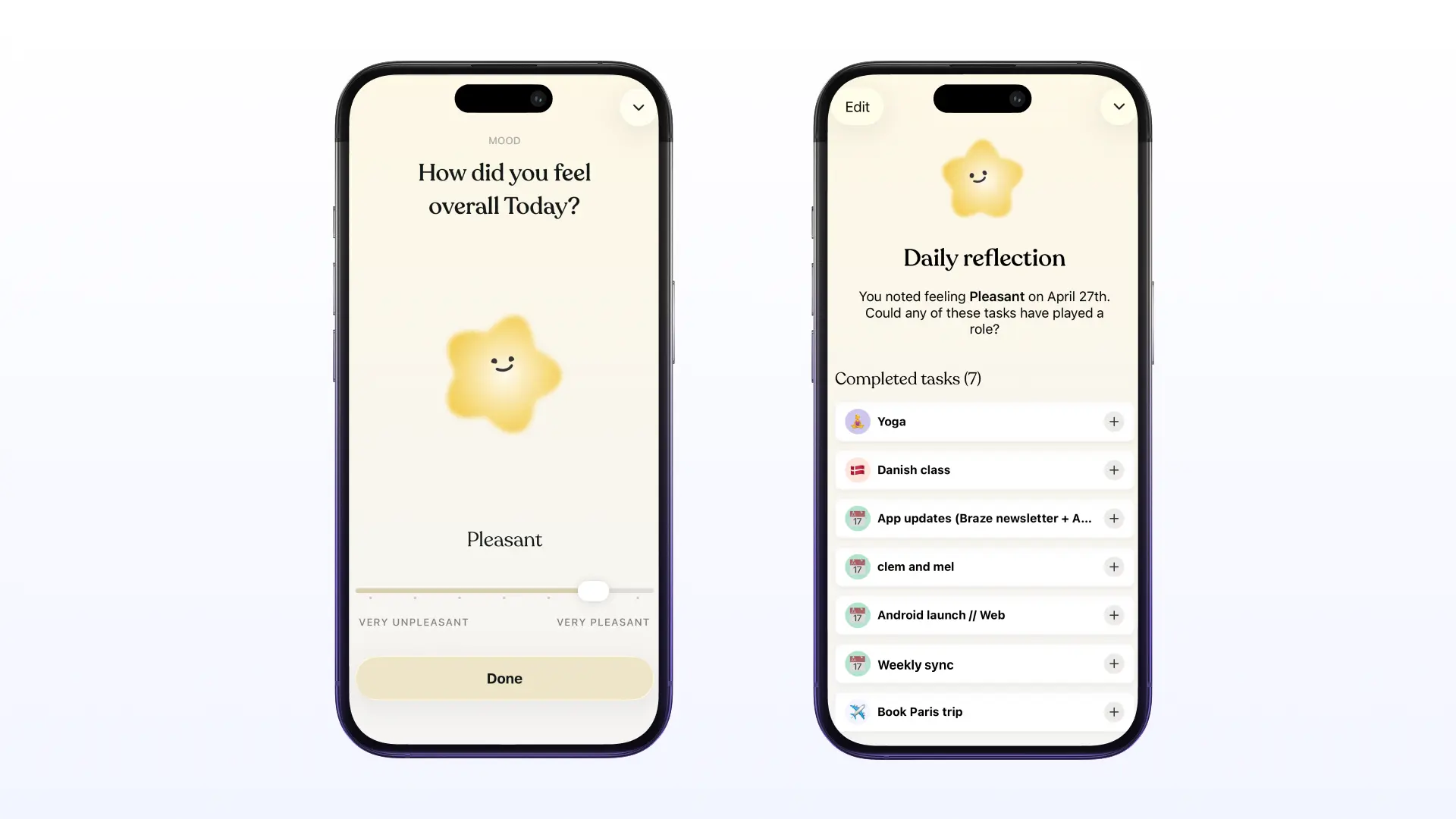
Energy-based planning starts from a simple premise: not all tasks require the same brain, and not all moments have the same brain to offer. Rather than organizing by importance or deadline, you sort by what you can actually access right now, saving the complex, focus-heavy work for peak moments and leaving lighter tasks for when your capacity is lower. A 2024 study by Turjeman-Levi and colleagues in AIMS Public Health found that poor time management and disorganization specifically drove the relationship between ADHD and job burnout, with energy mismanagement feeding physical fatigue and organizational struggles contributing to emotional exhaustion. Planning around how you actually feel, rather than how a system assumes you should feel, directly addresses one of the main drivers of that cycle. Tiimo's wellbeing tracker supports this by letting you log how you're feeling throughout the day, spot patterns over time, and build a clearer picture of when your brain is actually at its best.
A good place to start: try sorting your tasks into three loose buckets before your day begins, and keep in mind that these categories are entirely personal. What drains you completely on one day might feel effortless on another, so trust your own read on your energy rather than assuming some tasks are objectively harder than others. A text message can take everything you've got some days, while reorganizing your whole desk feels like nothing. With that in mind: high energy tasks that need real focus, medium energy tasks that need some attention but not your best brain, and low energy tasks you can do on autopilot. Match them to how you actually feel when you sit down to work, rather than what the calendar says you should be doing.
Where rigid systems ask you to do the most important thing first, motivation-first planning asks what you can actually activate on right now, and builds momentum from there toward harder tasks. This might look like using interest and challenge as the primary sorting mechanism for your day, or setting up if-then intentions where a smaller, more accessible task acts as a runway into a larger one. Research on implementation intentions suggests this approach meaningfully reduces the task initiation barrier by replacing a vague, general goal with a specific situational cue, which asks much less of the executive function resources that ADHD strains.
Dopamine menus are worth trying here too: a pre-prepared list of activities that provide reliable stimulation, used as rewards between tasks. The point is to decide what your breaks look like before you need them, so you're not burning cognitive fuel on that decision in the moment when your brain is already running low.
One practical consequence of working memory difficulties and time agnosia is that carrying a plan around in your head is effortful in a way it simply isn't for everyone. Externalizing planning into a visual format reduces the ongoing cognitive load of what researchers call prospective memory, the work of remembering to remember. When your plan is visible, spatially laid out, and easy to adjust without rebuilding from scratch, it removes several of the executive function demands that cause rigid systems to collapse at the first disruption.
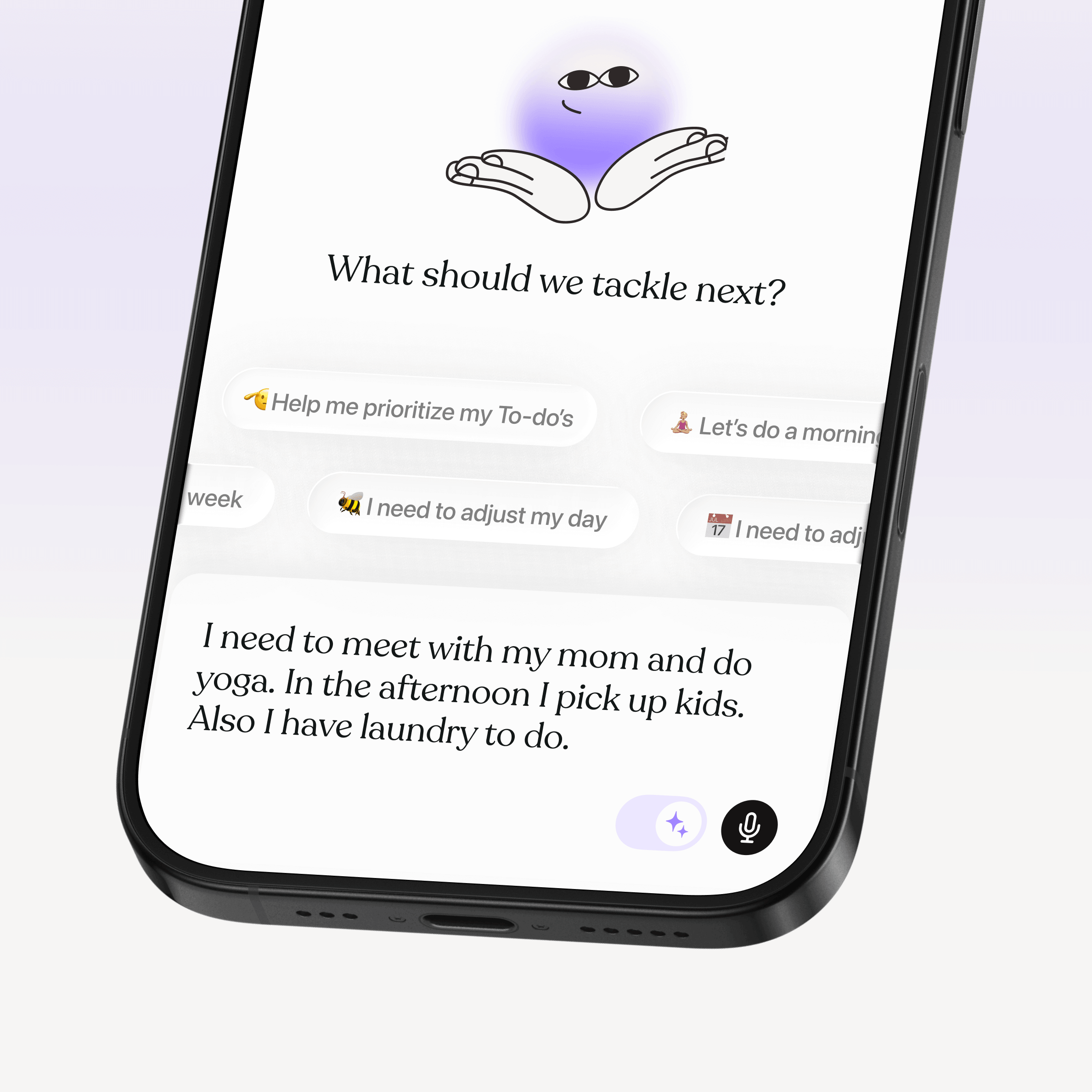
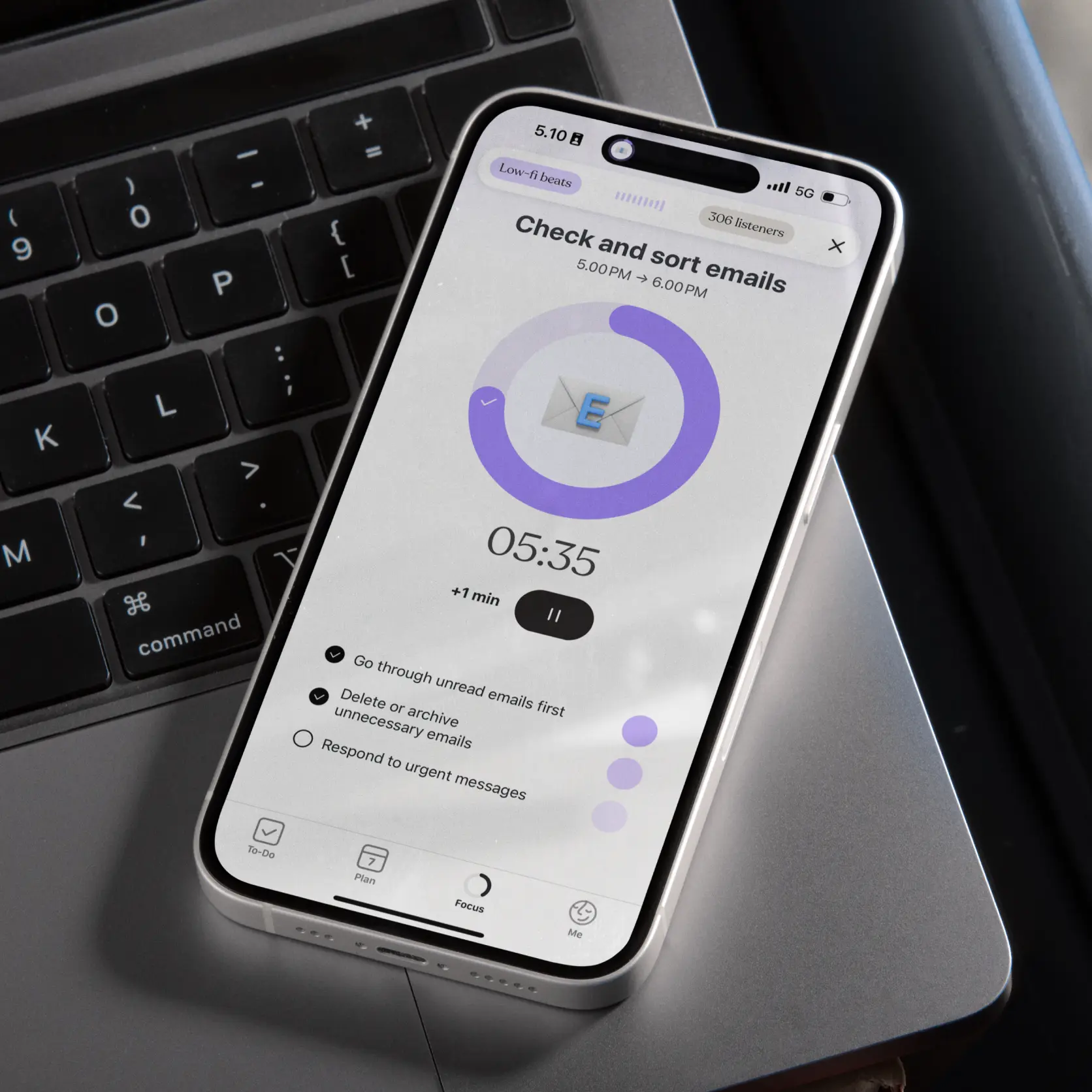
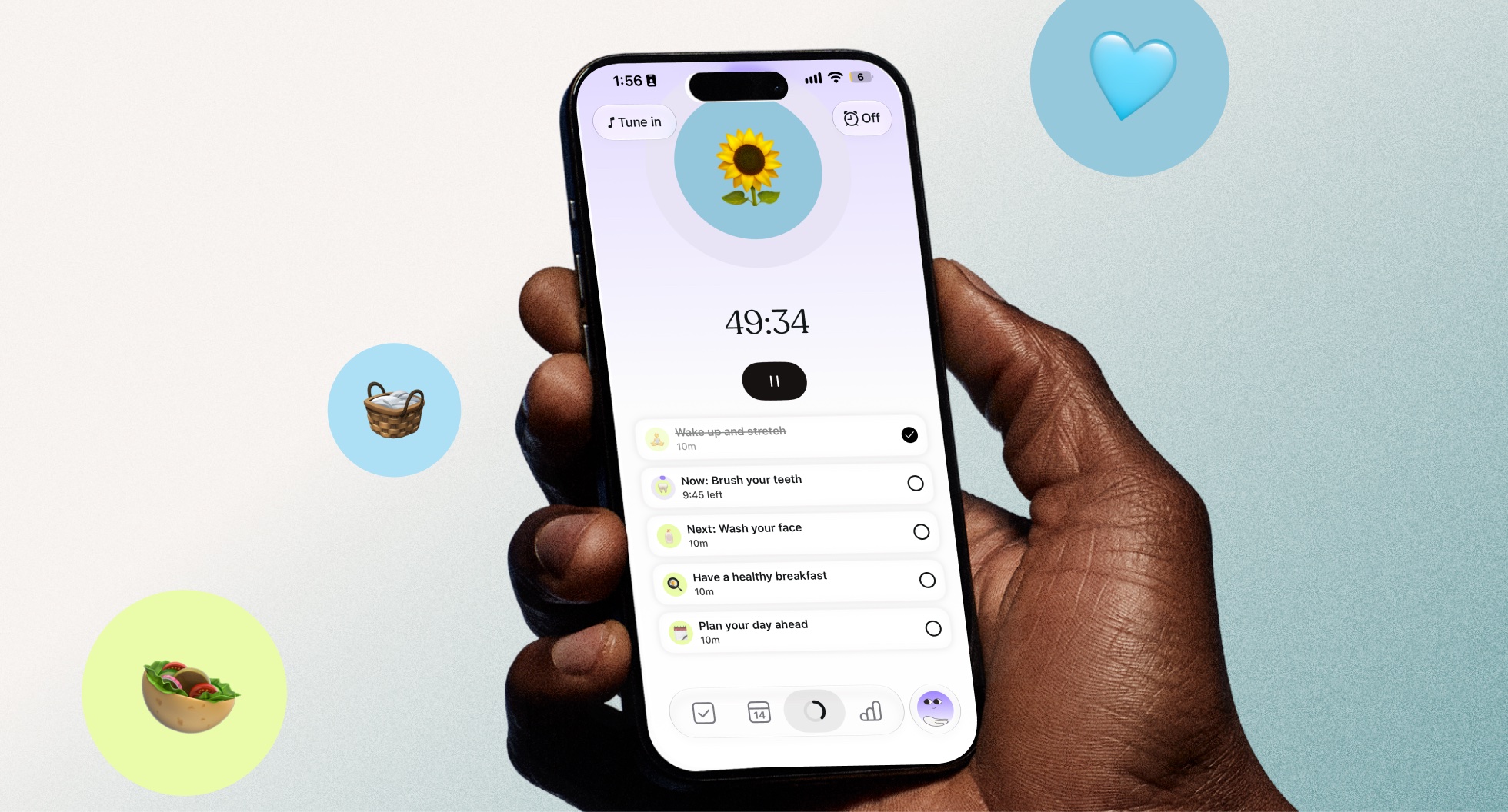
A static, importance-ranked to-do list asks you to hold the big picture in your head and re-engage the same decision every time you check back in, which is a lot to ask of a brain that's already stretched. A visual timeline that shows what's coming, how much time each thing takes, and what follows next externalizes those decisions rather than repeating them. Tiimo takes that a step further: unlike the planner you'll inevitably forget to open, it lives across your phone, your watch, and your laptop, so your plan is actually there when you need it. A color-coded daily timeline with drag-and-drop flexibility, a focus timer that makes time visible rather than abstract, and a to-do list designed as a low-pressure brain-dump space where tasks can live until you're ready to place them in your day.
Body doubling, working in the presence of another person who's also working, is one of the most consistently reported helpful strategies among ADHD'ers, and the research supports it. A 2021 study by Smith and Johnson in the Journal of Adult ADHD found that co-working environments boosted productivity for people with ADHD by providing external motivation and reducing distraction. The mechanism isn't accountability in a punitive sense but co-regulation: the presence of another person in focused work provides an environmental cue that helps orient your attention toward the task at hand. This doesn't have to mean finding a co-working space or scheduling sessions with a friend. Virtual body doubling through apps or even a YouTube study-with-me video can provide the same effect.
If you've cycled through planners and apps and methods and come out feeling like the common denominator in every failure, here's the actual explanation: those approaches weren't built for the way your brain works. ADHD affects motivation, time perception, working memory, and task initiation in ways that rigid, compliance-dependent systems simply can't accommodate, and no amount of discipline or determination changes that fundamental mismatch.
Part of what makes this so hard to untangle is that we live in a culture with an almost pathological obsession with productivity, one that has convinced many people that their worth is tied to their output and that struggling to keep up is a personal failing rather than a reasonable response to unreasonable expectations. That narrative is exhausting for everyone, and for ADHD'ers carrying an existing load of shame around executive function, it can quickly spiral into ADHD burnout.
What actually helps tends to be a mix of things rather than one perfect solution, a bit of energy-based planning here, some body doubling there, a visual timeline that actually travels with you. You try something, it works for a while, life disrupts it, you adjust. The path forward isn't trying harder with shinier tools but building something that starts from how your brain actually functions, with a lot more self-compassion and a lot less guilt than most productivity advice ever makes room for.
Most productivity advice assumes consistent motivation, reliable working memory, and a stable internal sense of time, none of which reflect how ADHD brains actually function. When a system relies on importance-based motivation, multi-step routines, or fixed time intervals, it's placing its heaviest demands on exactly the areas ADHD makes hardest.
There isn't one, and that's not a cop-out. ADHD presents differently across individuals, and flexibility is a feature, not a gap. The approaches with the strongest evidence base include energy-based task sorting, motivation-first planning, visual externalization of tasks and time, and environmental supports such as body doubling. The goal is something that adapts to how you actually are on a given day rather than demanding consistency your brain can't reliably produce.
A list organized by importance assumes that knowing something matters is enough to start it, which is exactly where ADHD motivation breaks down. Static lists also depend on prospective memory to be opened and consulted, one of the specific cognitive functions most affected by ADHD. The issue isn't having a list, it's having one that's connected to a visual timeline, flexibly prioritized, and low-friction enough to actually use.
Energy-based productivity matches tasks to your cognitive capacity in the moment rather than to fixed time slots or importance rankings. It treats variability in focus and motivation as a given and organizes your day around it rather than fighting it.
INCUP is based on Dr. Russell Barkley's research on ADHD and the interest-based nervous system. It describes the conditions under which ADHD brains reliably engage: Interest, Novelty, Challenge, Urgency, and Passion. It's a more accurate model of ADHD motivation than the assumption that importance alone is enough to get started.
Both describe the same experience: a neurological difference in how ADHD brains perceive and track time, making it hard to estimate how long tasks take, notice time passing, or remember to do things at a future point. "Time agnosia" is increasingly preferred because it accurately reflects the neurological nature of what's happening, whereas "time blindness" used as a metaphor carries ableist implications by associating disability with a lack of awareness.
Altgassen, M., Scheres, A., & Edel, M.-A. (2019). Prospective memory (partially) mediates the link between ADHD symptoms and procrastination. Attention Deficit and Hyperactivity Disorders, 11(1), 59–71.
Ceroni, M., Rossi, S., Zerboni, G., Biglia, E., Soldini, E., Izzo, A., Morellini, L., & Sacco, L. (2022). Attentive-executive functioning and compensatory strategies in adult ADHD: A retrospective case series study. Frontiers in Psychology, 13, 1015102.
Kalmanovich-Cohen, H., & Stanton, S. J. (2023). How can work from home support neurodiversity and inclusion? Industrial and Organizational Psychology, 16(1), 20–24.
Masuch, T. V., Bea, M., Alm, B., Deibler, P., & Sobanski, E. (2019). Internalized stigma, anticipated discrimination and perceived public stigma in adults with ADHD. Attention Deficit and Hyperactivity Disorders, 11(2), 211–220.
Mette, C. (2023). Time perception in adult ADHD: Findings from a decade, a review. International Journal of Environmental Research and Public Health, 20(4), 3098.
Oroian, B. A., Nechita, P., & Szalontay, A. (2025). Hyperfocus in ADHD: A misunderstood cognitive phenomenon. European Psychiatry, 68(Suppl 1), S306.
Smith, A. M., & Johnson, R. L. (2021). Co-working and ADHD: Boosting productivity through shared spaces. Journal of Adult ADHD, 10(4), 323–332.
Turjeman-Levi, Y., Itzchakov, G., Engel-Yeger, B., & Bart, O. (2024). Executive function deficits mediate the relationship between ADHD and job burnout in employees. AIMS Public Health, 11(1), 294–314.
Volkow, N. D., Wang, G.-J., Newcorn, J. H., Kollins, S. H., Wigal, T. L., Telang, F., Fowler, J. S., Goldstein, R. Z., Klein, N., Logan, J., Wong, C., & Swanson, J. M. (2011). Motivation deficit in ADHD is associated with dysfunction of the dopamine reward pathway. Molecular Psychiatry, 16(11), 1147–1154.

Most productivity advice was never designed for how ADHD works. Here's why popular systems keep failing, and what actually works instead.
Somewhere out there is a very confident person who wants you to know that the reason you're not getting things done is because you haven't followed the right advice yet. Maybe it's a planner with a morning ritual section. Maybe it's color-coding your calendar, or eating the frog, or Getting Things Done, or the Pomodoro technique, or just writing your three most important tasks on a sticky note before breakfast. The advice is everywhere, delivered with total certainty, and for a significant portion of the people receiving it, it simply doesn't work.
For ADHD'ers, that failure tends to follow a recognizable pattern: you try the thing, it holds for a few days, life disrupts it, and instead of picking it back up, you find yourself convinced that you're the problem. The planner sits unopened. The perfectly organized calendar goes untouched. The app you downloaded gets buried until the subscription renews, and you delete it out of guilt.
What rarely gets said is that most mainstream productivity advice was built around a cognitive profile that describes very few people living full and complicated lives: consistent energy across the day, reliable working memory, a stable internal sense of time, and the ability to move from deciding to do something to actually starting it on demand. For ADHD'ers especially, almost none of those assumptions hold, and the gap between what the advice expects and what the brain can actually deliver comes down to a flaw in the design of the advice itself.
GTD. MIT lists. PKM. PARA. Time blocking. Eat the frog. Rise and grind. The five AM club. The one thing. Deep work. Your morning routine is your life routine. Billionaires wake up at four.
We live in a culture that has turned productivity into a personality, and with it came an entire industry of self-proclaimed experts, bestselling frameworks, viral LinkedIn posts, and books that all promise the same thing: that the reason you're not doing enough is because you haven't found the right system yet. That framing isn't neutral; it places the failure squarely on you, and for ADHD'ers especially, it tends to land on top of a pile of shame that was already there before any of these systems even got a chance to fail.
Some of the methods floating around in this space can work for ADHD'ers with the right adaptations, and you might have seen Tiimo cover a few of them with exactly that framing. The problem isn't any single tool so much as the version most people encounter: rigid, universal, and built on assumptions that don't hold for most brains, let alone ADHD ones.
To understand why these systems fail so reliably, we need to look at what ADHD actually does to the brain, and how fundamentally it shapes motivation, time perception, and the basic mechanics of getting started.
One of the most useful frameworks comes from the work of Dr. Russell Barkley, whose research into executive function has been foundational in the field. Barkley describes what he calls an interest-based nervous system, sometimes referenced through the INCUP framework, which identifies the conditions under which ADHD brains reliably engage: Interest, Novelty, Challenge, Urgency, and Passion. For ADHD'ers, motivation doesn't come from deciding something is important and then doing it, because importance alone isn't enough to get the brain moving.
This isn't a mindset problem or a values issue, and the research backs that up. A 2011 study by Volkow and colleagues in Molecular Psychiatry found that motivation deficits in ADHD are linked to differences in how dopamine, the neurotransmitter central to reward and motivation, is released in the brain's reward circuits, meaning the ADHD brain often simply doesn't produce the chemical signal that makes a task feel worth starting, even when you want to do it and understand why it matters. This is exactly why importance-ranked to-do lists miss the point entirely for ADHD'ers: knowing something matters and feeling motivated to start it are not the same thing.
Executive functions are the cognitive processes involved in planning, organizing, initiating tasks, holding information in working memory, and regulating responses to the environment. Research by Ceroni and colleagues, published in Frontiers in Psychology in 2022, found that ADHD'ers show significant difficulties across all of these processes, with real downstream effects on how tasks get managed in daily life. What's striking is how much of the maintenance work required by popular productivity methods is itself an executive function demand before any actual work has even begun.
GTD asks you to capture every task, process each item, organize it into a category, and review your lists on a schedule, each step stacked on top of the last. Time blocking requires estimating task duration, assigning work to specific slots, holding that structure in mind all day, and adjusting when things shift. For people whose executive function operates smoothly, those steps feel like background noise, but for ADHD'ers they're often the hardest part of the whole thing, and the advice places every single one of them right at the door.
One of the less-discussed but deeply consequential features of ADHD is what it does to time perception. A 2023 review by Mette in the International Journal of Environmental Research and Public Health found consistent evidence that ADHD'ers experience an altered internal sense of time, including difficulty estimating how long tasks will take, losing track of how much time has passed, and struggling with prospective memory, which is the ability to remember to do something at a future point. This is often called time agnosia, though you might also see it referred to as "time blindness," a term many people are moving away from since using "blindness" as a metaphor carries ableist implications.
The consequences for schedule-based systems are predictable: a time-blocked day assumes you'll notice when thirty minutes have passed and smoothly transition to the next task, which ADHD time perception doesn't reliably support. A Pomodoro timer will either cut across hyperfocus at exactly the moment it's finally working, or go entirely unnoticed while an hour disappears. A 2025 study by Oroian and colleagues in European Psychiatry found that while around 30% of ADHD'ers experienced heightened productivity during hyperfocus in flexible work settings, it often came at the cost of neglected responsibilities elsewhere, which captures something true about how the all-or-nothing nature of ADHD attention resists being divided into neat intervals. Prospective memory difficulties also partially explain the link between ADHD and procrastination, as Altgassen and colleagues found in a 2019 study in Attention Deficit and Hyperactivity Disorders: the planner doesn't help if you forget to open it, and the reminder doesn't land if the habit of checking it never formed.
There's a particular cruelty in the fact that productivity systems tend to work for ADHD'ers at the start. The INCUP framework helps explain why: a new system brings novelty, and novelty is one of the reliable activation conditions for ADHD brains. That initial dopamine response creates a real window of engagement that can look and feel like the system is finally working, right up until it isn't new anymore. At that point, the novelty fades, the system becomes another low-interest routine, and the same executive function challenges that made a system necessary in the first place make it very hard to maintain. This is a predictable neurological response to the withdrawal of the stimulus that made the behavior possible, and it has nothing to do with how badly you wanted it to work.
The cumulative effect of repeated failure goes deeper than a graveyard of unused apps and unopened planners. Research by Masuch and colleagues, published in Attention Deficit and Hyperactivity Disorders in 2019, found that internalized stigma is highly prevalent among adult ADHD’ers, with around 23% reporting high levels correlating with lower self-esteem, psychological distress, and ADHD burnout. When a productivity approach fails, the dominant cultural narrative blames you rather than the design assumptions baked into the advice, and ADHD'ers tend to absorb that narrative. The shame that follows makes executive functioning worse, not better, and sets up the next attempt to fail for exactly the same reasons.
Here's the thing about structure: ADHD'ers usually need more of it, not less. It just needs to be responsive rather than prescriptive, built to meet your brain where it actually is on a given day.
Energy-based planning starts from a simple premise: not all tasks require the same brain, and not all moments have the same brain to offer. Rather than organizing by importance or deadline, you sort by what you can actually access right now, saving the complex, focus-heavy work for peak moments and leaving lighter tasks for when your capacity is lower. A 2024 study by Turjeman-Levi and colleagues in AIMS Public Health found that poor time management and disorganization specifically drove the relationship between ADHD and job burnout, with energy mismanagement feeding physical fatigue and organizational struggles contributing to emotional exhaustion. Planning around how you actually feel, rather than how a system assumes you should feel, directly addresses one of the main drivers of that cycle. Tiimo's wellbeing tracker supports this by letting you log how you're feeling throughout the day, spot patterns over time, and build a clearer picture of when your brain is actually at its best.
A good place to start: try sorting your tasks into three loose buckets before your day begins, and keep in mind that these categories are entirely personal. What drains you completely on one day might feel effortless on another, so trust your own read on your energy rather than assuming some tasks are objectively harder than others. A text message can take everything you've got some days, while reorganizing your whole desk feels like nothing. With that in mind: high energy tasks that need real focus, medium energy tasks that need some attention but not your best brain, and low energy tasks you can do on autopilot. Match them to how you actually feel when you sit down to work, rather than what the calendar says you should be doing.
Where rigid systems ask you to do the most important thing first, motivation-first planning asks what you can actually activate on right now, and builds momentum from there toward harder tasks. This might look like using interest and challenge as the primary sorting mechanism for your day, or setting up if-then intentions where a smaller, more accessible task acts as a runway into a larger one. Research on implementation intentions suggests this approach meaningfully reduces the task initiation barrier by replacing a vague, general goal with a specific situational cue, which asks much less of the executive function resources that ADHD strains.
Dopamine menus are worth trying here too: a pre-prepared list of activities that provide reliable stimulation, used as rewards between tasks. The point is to decide what your breaks look like before you need them, so you're not burning cognitive fuel on that decision in the moment when your brain is already running low.
One practical consequence of working memory difficulties and time agnosia is that carrying a plan around in your head is effortful in a way it simply isn't for everyone. Externalizing planning into a visual format reduces the ongoing cognitive load of what researchers call prospective memory, the work of remembering to remember. When your plan is visible, spatially laid out, and easy to adjust without rebuilding from scratch, it removes several of the executive function demands that cause rigid systems to collapse at the first disruption.
A static, importance-ranked to-do list asks you to hold the big picture in your head and re-engage the same decision every time you check back in, which is a lot to ask of a brain that's already stretched. A visual timeline that shows what's coming, how much time each thing takes, and what follows next externalizes those decisions rather than repeating them. Tiimo takes that a step further: unlike the planner you'll inevitably forget to open, it lives across your phone, your watch, and your laptop, so your plan is actually there when you need it. A color-coded daily timeline with drag-and-drop flexibility, a focus timer that makes time visible rather than abstract, and a to-do list designed as a low-pressure brain-dump space where tasks can live until you're ready to place them in your day.
Body doubling, working in the presence of another person who's also working, is one of the most consistently reported helpful strategies among ADHD'ers, and the research supports it. A 2021 study by Smith and Johnson in the Journal of Adult ADHD found that co-working environments boosted productivity for people with ADHD by providing external motivation and reducing distraction. The mechanism isn't accountability in a punitive sense but co-regulation: the presence of another person in focused work provides an environmental cue that helps orient your attention toward the task at hand. This doesn't have to mean finding a co-working space or scheduling sessions with a friend. Virtual body doubling through apps or even a YouTube study-with-me video can provide the same effect.
If you've cycled through planners and apps and methods and come out feeling like the common denominator in every failure, here's the actual explanation: those approaches weren't built for the way your brain works. ADHD affects motivation, time perception, working memory, and task initiation in ways that rigid, compliance-dependent systems simply can't accommodate, and no amount of discipline or determination changes that fundamental mismatch.
Part of what makes this so hard to untangle is that we live in a culture with an almost pathological obsession with productivity, one that has convinced many people that their worth is tied to their output and that struggling to keep up is a personal failing rather than a reasonable response to unreasonable expectations. That narrative is exhausting for everyone, and for ADHD'ers carrying an existing load of shame around executive function, it can quickly spiral into ADHD burnout.
What actually helps tends to be a mix of things rather than one perfect solution, a bit of energy-based planning here, some body doubling there, a visual timeline that actually travels with you. You try something, it works for a while, life disrupts it, you adjust. The path forward isn't trying harder with shinier tools but building something that starts from how your brain actually functions, with a lot more self-compassion and a lot less guilt than most productivity advice ever makes room for.
Most productivity advice assumes consistent motivation, reliable working memory, and a stable internal sense of time, none of which reflect how ADHD brains actually function. When a system relies on importance-based motivation, multi-step routines, or fixed time intervals, it's placing its heaviest demands on exactly the areas ADHD makes hardest.
There isn't one, and that's not a cop-out. ADHD presents differently across individuals, and flexibility is a feature, not a gap. The approaches with the strongest evidence base include energy-based task sorting, motivation-first planning, visual externalization of tasks and time, and environmental supports such as body doubling. The goal is something that adapts to how you actually are on a given day rather than demanding consistency your brain can't reliably produce.
A list organized by importance assumes that knowing something matters is enough to start it, which is exactly where ADHD motivation breaks down. Static lists also depend on prospective memory to be opened and consulted, one of the specific cognitive functions most affected by ADHD. The issue isn't having a list, it's having one that's connected to a visual timeline, flexibly prioritized, and low-friction enough to actually use.
Energy-based productivity matches tasks to your cognitive capacity in the moment rather than to fixed time slots or importance rankings. It treats variability in focus and motivation as a given and organizes your day around it rather than fighting it.
INCUP is based on Dr. Russell Barkley's research on ADHD and the interest-based nervous system. It describes the conditions under which ADHD brains reliably engage: Interest, Novelty, Challenge, Urgency, and Passion. It's a more accurate model of ADHD motivation than the assumption that importance alone is enough to get started.
Both describe the same experience: a neurological difference in how ADHD brains perceive and track time, making it hard to estimate how long tasks take, notice time passing, or remember to do things at a future point. "Time agnosia" is increasingly preferred because it accurately reflects the neurological nature of what's happening, whereas "time blindness" used as a metaphor carries ableist implications by associating disability with a lack of awareness.
Altgassen, M., Scheres, A., & Edel, M.-A. (2019). Prospective memory (partially) mediates the link between ADHD symptoms and procrastination. Attention Deficit and Hyperactivity Disorders, 11(1), 59–71.
Ceroni, M., Rossi, S., Zerboni, G., Biglia, E., Soldini, E., Izzo, A., Morellini, L., & Sacco, L. (2022). Attentive-executive functioning and compensatory strategies in adult ADHD: A retrospective case series study. Frontiers in Psychology, 13, 1015102.
Kalmanovich-Cohen, H., & Stanton, S. J. (2023). How can work from home support neurodiversity and inclusion? Industrial and Organizational Psychology, 16(1), 20–24.
Masuch, T. V., Bea, M., Alm, B., Deibler, P., & Sobanski, E. (2019). Internalized stigma, anticipated discrimination and perceived public stigma in adults with ADHD. Attention Deficit and Hyperactivity Disorders, 11(2), 211–220.
Mette, C. (2023). Time perception in adult ADHD: Findings from a decade, a review. International Journal of Environmental Research and Public Health, 20(4), 3098.
Oroian, B. A., Nechita, P., & Szalontay, A. (2025). Hyperfocus in ADHD: A misunderstood cognitive phenomenon. European Psychiatry, 68(Suppl 1), S306.
Smith, A. M., & Johnson, R. L. (2021). Co-working and ADHD: Boosting productivity through shared spaces. Journal of Adult ADHD, 10(4), 323–332.
Turjeman-Levi, Y., Itzchakov, G., Engel-Yeger, B., & Bart, O. (2024). Executive function deficits mediate the relationship between ADHD and job burnout in employees. AIMS Public Health, 11(1), 294–314.
Volkow, N. D., Wang, G.-J., Newcorn, J. H., Kollins, S. H., Wigal, T. L., Telang, F., Fowler, J. S., Goldstein, R. Z., Klein, N., Logan, J., Wong, C., & Swanson, J. M. (2011). Motivation deficit in ADHD is associated with dysfunction of the dopamine reward pathway. Molecular Psychiatry, 16(11), 1147–1154.
Most productivity advice was never designed for how ADHD works. Here's why popular systems keep failing, and what actually works instead.


Somewhere out there is a very confident person who wants you to know that the reason you're not getting things done is because you haven't followed the right advice yet. Maybe it's a planner with a morning ritual section. Maybe it's color-coding your calendar, or eating the frog, or Getting Things Done, or the Pomodoro technique, or just writing your three most important tasks on a sticky note before breakfast. The advice is everywhere, delivered with total certainty, and for a significant portion of the people receiving it, it simply doesn't work.
For ADHD'ers, that failure tends to follow a recognizable pattern: you try the thing, it holds for a few days, life disrupts it, and instead of picking it back up, you find yourself convinced that you're the problem. The planner sits unopened. The perfectly organized calendar goes untouched. The app you downloaded gets buried until the subscription renews, and you delete it out of guilt.
What rarely gets said is that most mainstream productivity advice was built around a cognitive profile that describes very few people living full and complicated lives: consistent energy across the day, reliable working memory, a stable internal sense of time, and the ability to move from deciding to do something to actually starting it on demand. For ADHD'ers especially, almost none of those assumptions hold, and the gap between what the advice expects and what the brain can actually deliver comes down to a flaw in the design of the advice itself.
GTD. MIT lists. PKM. PARA. Time blocking. Eat the frog. Rise and grind. The five AM club. The one thing. Deep work. Your morning routine is your life routine. Billionaires wake up at four.
We live in a culture that has turned productivity into a personality, and with it came an entire industry of self-proclaimed experts, bestselling frameworks, viral LinkedIn posts, and books that all promise the same thing: that the reason you're not doing enough is because you haven't found the right system yet. That framing isn't neutral; it places the failure squarely on you, and for ADHD'ers especially, it tends to land on top of a pile of shame that was already there before any of these systems even got a chance to fail.
Some of the methods floating around in this space can work for ADHD'ers with the right adaptations, and you might have seen Tiimo cover a few of them with exactly that framing. The problem isn't any single tool so much as the version most people encounter: rigid, universal, and built on assumptions that don't hold for most brains, let alone ADHD ones.
To understand why these systems fail so reliably, we need to look at what ADHD actually does to the brain, and how fundamentally it shapes motivation, time perception, and the basic mechanics of getting started.
One of the most useful frameworks comes from the work of Dr. Russell Barkley, whose research into executive function has been foundational in the field. Barkley describes what he calls an interest-based nervous system, sometimes referenced through the INCUP framework, which identifies the conditions under which ADHD brains reliably engage: Interest, Novelty, Challenge, Urgency, and Passion. For ADHD'ers, motivation doesn't come from deciding something is important and then doing it, because importance alone isn't enough to get the brain moving.
This isn't a mindset problem or a values issue, and the research backs that up. A 2011 study by Volkow and colleagues in Molecular Psychiatry found that motivation deficits in ADHD are linked to differences in how dopamine, the neurotransmitter central to reward and motivation, is released in the brain's reward circuits, meaning the ADHD brain often simply doesn't produce the chemical signal that makes a task feel worth starting, even when you want to do it and understand why it matters. This is exactly why importance-ranked to-do lists miss the point entirely for ADHD'ers: knowing something matters and feeling motivated to start it are not the same thing.
Executive functions are the cognitive processes involved in planning, organizing, initiating tasks, holding information in working memory, and regulating responses to the environment. Research by Ceroni and colleagues, published in Frontiers in Psychology in 2022, found that ADHD'ers show significant difficulties across all of these processes, with real downstream effects on how tasks get managed in daily life. What's striking is how much of the maintenance work required by popular productivity methods is itself an executive function demand before any actual work has even begun.
GTD asks you to capture every task, process each item, organize it into a category, and review your lists on a schedule, each step stacked on top of the last. Time blocking requires estimating task duration, assigning work to specific slots, holding that structure in mind all day, and adjusting when things shift. For people whose executive function operates smoothly, those steps feel like background noise, but for ADHD'ers they're often the hardest part of the whole thing, and the advice places every single one of them right at the door.
One of the less-discussed but deeply consequential features of ADHD is what it does to time perception. A 2023 review by Mette in the International Journal of Environmental Research and Public Health found consistent evidence that ADHD'ers experience an altered internal sense of time, including difficulty estimating how long tasks will take, losing track of how much time has passed, and struggling with prospective memory, which is the ability to remember to do something at a future point. This is often called time agnosia, though you might also see it referred to as "time blindness," a term many people are moving away from since using "blindness" as a metaphor carries ableist implications.
The consequences for schedule-based systems are predictable: a time-blocked day assumes you'll notice when thirty minutes have passed and smoothly transition to the next task, which ADHD time perception doesn't reliably support. A Pomodoro timer will either cut across hyperfocus at exactly the moment it's finally working, or go entirely unnoticed while an hour disappears. A 2025 study by Oroian and colleagues in European Psychiatry found that while around 30% of ADHD'ers experienced heightened productivity during hyperfocus in flexible work settings, it often came at the cost of neglected responsibilities elsewhere, which captures something true about how the all-or-nothing nature of ADHD attention resists being divided into neat intervals. Prospective memory difficulties also partially explain the link between ADHD and procrastination, as Altgassen and colleagues found in a 2019 study in Attention Deficit and Hyperactivity Disorders: the planner doesn't help if you forget to open it, and the reminder doesn't land if the habit of checking it never formed.
There's a particular cruelty in the fact that productivity systems tend to work for ADHD'ers at the start. The INCUP framework helps explain why: a new system brings novelty, and novelty is one of the reliable activation conditions for ADHD brains. That initial dopamine response creates a real window of engagement that can look and feel like the system is finally working, right up until it isn't new anymore. At that point, the novelty fades, the system becomes another low-interest routine, and the same executive function challenges that made a system necessary in the first place make it very hard to maintain. This is a predictable neurological response to the withdrawal of the stimulus that made the behavior possible, and it has nothing to do with how badly you wanted it to work.
The cumulative effect of repeated failure goes deeper than a graveyard of unused apps and unopened planners. Research by Masuch and colleagues, published in Attention Deficit and Hyperactivity Disorders in 2019, found that internalized stigma is highly prevalent among adult ADHD’ers, with around 23% reporting high levels correlating with lower self-esteem, psychological distress, and ADHD burnout. When a productivity approach fails, the dominant cultural narrative blames you rather than the design assumptions baked into the advice, and ADHD'ers tend to absorb that narrative. The shame that follows makes executive functioning worse, not better, and sets up the next attempt to fail for exactly the same reasons.
Here's the thing about structure: ADHD'ers usually need more of it, not less. It just needs to be responsive rather than prescriptive, built to meet your brain where it actually is on a given day.
Energy-based planning starts from a simple premise: not all tasks require the same brain, and not all moments have the same brain to offer. Rather than organizing by importance or deadline, you sort by what you can actually access right now, saving the complex, focus-heavy work for peak moments and leaving lighter tasks for when your capacity is lower. A 2024 study by Turjeman-Levi and colleagues in AIMS Public Health found that poor time management and disorganization specifically drove the relationship between ADHD and job burnout, with energy mismanagement feeding physical fatigue and organizational struggles contributing to emotional exhaustion. Planning around how you actually feel, rather than how a system assumes you should feel, directly addresses one of the main drivers of that cycle. Tiimo's wellbeing tracker supports this by letting you log how you're feeling throughout the day, spot patterns over time, and build a clearer picture of when your brain is actually at its best.
A good place to start: try sorting your tasks into three loose buckets before your day begins, and keep in mind that these categories are entirely personal. What drains you completely on one day might feel effortless on another, so trust your own read on your energy rather than assuming some tasks are objectively harder than others. A text message can take everything you've got some days, while reorganizing your whole desk feels like nothing. With that in mind: high energy tasks that need real focus, medium energy tasks that need some attention but not your best brain, and low energy tasks you can do on autopilot. Match them to how you actually feel when you sit down to work, rather than what the calendar says you should be doing.
Where rigid systems ask you to do the most important thing first, motivation-first planning asks what you can actually activate on right now, and builds momentum from there toward harder tasks. This might look like using interest and challenge as the primary sorting mechanism for your day, or setting up if-then intentions where a smaller, more accessible task acts as a runway into a larger one. Research on implementation intentions suggests this approach meaningfully reduces the task initiation barrier by replacing a vague, general goal with a specific situational cue, which asks much less of the executive function resources that ADHD strains.
Dopamine menus are worth trying here too: a pre-prepared list of activities that provide reliable stimulation, used as rewards between tasks. The point is to decide what your breaks look like before you need them, so you're not burning cognitive fuel on that decision in the moment when your brain is already running low.
One practical consequence of working memory difficulties and time agnosia is that carrying a plan around in your head is effortful in a way it simply isn't for everyone. Externalizing planning into a visual format reduces the ongoing cognitive load of what researchers call prospective memory, the work of remembering to remember. When your plan is visible, spatially laid out, and easy to adjust without rebuilding from scratch, it removes several of the executive function demands that cause rigid systems to collapse at the first disruption.
A static, importance-ranked to-do list asks you to hold the big picture in your head and re-engage the same decision every time you check back in, which is a lot to ask of a brain that's already stretched. A visual timeline that shows what's coming, how much time each thing takes, and what follows next externalizes those decisions rather than repeating them. Tiimo takes that a step further: unlike the planner you'll inevitably forget to open, it lives across your phone, your watch, and your laptop, so your plan is actually there when you need it. A color-coded daily timeline with drag-and-drop flexibility, a focus timer that makes time visible rather than abstract, and a to-do list designed as a low-pressure brain-dump space where tasks can live until you're ready to place them in your day.
Body doubling, working in the presence of another person who's also working, is one of the most consistently reported helpful strategies among ADHD'ers, and the research supports it. A 2021 study by Smith and Johnson in the Journal of Adult ADHD found that co-working environments boosted productivity for people with ADHD by providing external motivation and reducing distraction. The mechanism isn't accountability in a punitive sense but co-regulation: the presence of another person in focused work provides an environmental cue that helps orient your attention toward the task at hand. This doesn't have to mean finding a co-working space or scheduling sessions with a friend. Virtual body doubling through apps or even a YouTube study-with-me video can provide the same effect.
If you've cycled through planners and apps and methods and come out feeling like the common denominator in every failure, here's the actual explanation: those approaches weren't built for the way your brain works. ADHD affects motivation, time perception, working memory, and task initiation in ways that rigid, compliance-dependent systems simply can't accommodate, and no amount of discipline or determination changes that fundamental mismatch.
Part of what makes this so hard to untangle is that we live in a culture with an almost pathological obsession with productivity, one that has convinced many people that their worth is tied to their output and that struggling to keep up is a personal failing rather than a reasonable response to unreasonable expectations. That narrative is exhausting for everyone, and for ADHD'ers carrying an existing load of shame around executive function, it can quickly spiral into ADHD burnout.
What actually helps tends to be a mix of things rather than one perfect solution, a bit of energy-based planning here, some body doubling there, a visual timeline that actually travels with you. You try something, it works for a while, life disrupts it, you adjust. The path forward isn't trying harder with shinier tools but building something that starts from how your brain actually functions, with a lot more self-compassion and a lot less guilt than most productivity advice ever makes room for.
Most productivity advice assumes consistent motivation, reliable working memory, and a stable internal sense of time, none of which reflect how ADHD brains actually function. When a system relies on importance-based motivation, multi-step routines, or fixed time intervals, it's placing its heaviest demands on exactly the areas ADHD makes hardest.
There isn't one, and that's not a cop-out. ADHD presents differently across individuals, and flexibility is a feature, not a gap. The approaches with the strongest evidence base include energy-based task sorting, motivation-first planning, visual externalization of tasks and time, and environmental supports such as body doubling. The goal is something that adapts to how you actually are on a given day rather than demanding consistency your brain can't reliably produce.
A list organized by importance assumes that knowing something matters is enough to start it, which is exactly where ADHD motivation breaks down. Static lists also depend on prospective memory to be opened and consulted, one of the specific cognitive functions most affected by ADHD. The issue isn't having a list, it's having one that's connected to a visual timeline, flexibly prioritized, and low-friction enough to actually use.
Energy-based productivity matches tasks to your cognitive capacity in the moment rather than to fixed time slots or importance rankings. It treats variability in focus and motivation as a given and organizes your day around it rather than fighting it.
INCUP is based on Dr. Russell Barkley's research on ADHD and the interest-based nervous system. It describes the conditions under which ADHD brains reliably engage: Interest, Novelty, Challenge, Urgency, and Passion. It's a more accurate model of ADHD motivation than the assumption that importance alone is enough to get started.
Both describe the same experience: a neurological difference in how ADHD brains perceive and track time, making it hard to estimate how long tasks take, notice time passing, or remember to do things at a future point. "Time agnosia" is increasingly preferred because it accurately reflects the neurological nature of what's happening, whereas "time blindness" used as a metaphor carries ableist implications by associating disability with a lack of awareness.
Altgassen, M., Scheres, A., & Edel, M.-A. (2019). Prospective memory (partially) mediates the link between ADHD symptoms and procrastination. Attention Deficit and Hyperactivity Disorders, 11(1), 59–71.
Ceroni, M., Rossi, S., Zerboni, G., Biglia, E., Soldini, E., Izzo, A., Morellini, L., & Sacco, L. (2022). Attentive-executive functioning and compensatory strategies in adult ADHD: A retrospective case series study. Frontiers in Psychology, 13, 1015102.
Kalmanovich-Cohen, H., & Stanton, S. J. (2023). How can work from home support neurodiversity and inclusion? Industrial and Organizational Psychology, 16(1), 20–24.
Masuch, T. V., Bea, M., Alm, B., Deibler, P., & Sobanski, E. (2019). Internalized stigma, anticipated discrimination and perceived public stigma in adults with ADHD. Attention Deficit and Hyperactivity Disorders, 11(2), 211–220.
Mette, C. (2023). Time perception in adult ADHD: Findings from a decade, a review. International Journal of Environmental Research and Public Health, 20(4), 3098.
Oroian, B. A., Nechita, P., & Szalontay, A. (2025). Hyperfocus in ADHD: A misunderstood cognitive phenomenon. European Psychiatry, 68(Suppl 1), S306.
Smith, A. M., & Johnson, R. L. (2021). Co-working and ADHD: Boosting productivity through shared spaces. Journal of Adult ADHD, 10(4), 323–332.
Turjeman-Levi, Y., Itzchakov, G., Engel-Yeger, B., & Bart, O. (2024). Executive function deficits mediate the relationship between ADHD and job burnout in employees. AIMS Public Health, 11(1), 294–314.
Volkow, N. D., Wang, G.-J., Newcorn, J. H., Kollins, S. H., Wigal, T. L., Telang, F., Fowler, J. S., Goldstein, R. Z., Klein, N., Logan, J., Wong, C., & Swanson, J. M. (2011). Motivation deficit in ADHD is associated with dysfunction of the dopamine reward pathway. Molecular Psychiatry, 16(11), 1147–1154.
When you're ready, try Tiimo and make structure a little easier.

Timers on subtasks make time visible for the smaller steps inside a task. Here’s what the feature does and how it gives you a clearer view as you go.
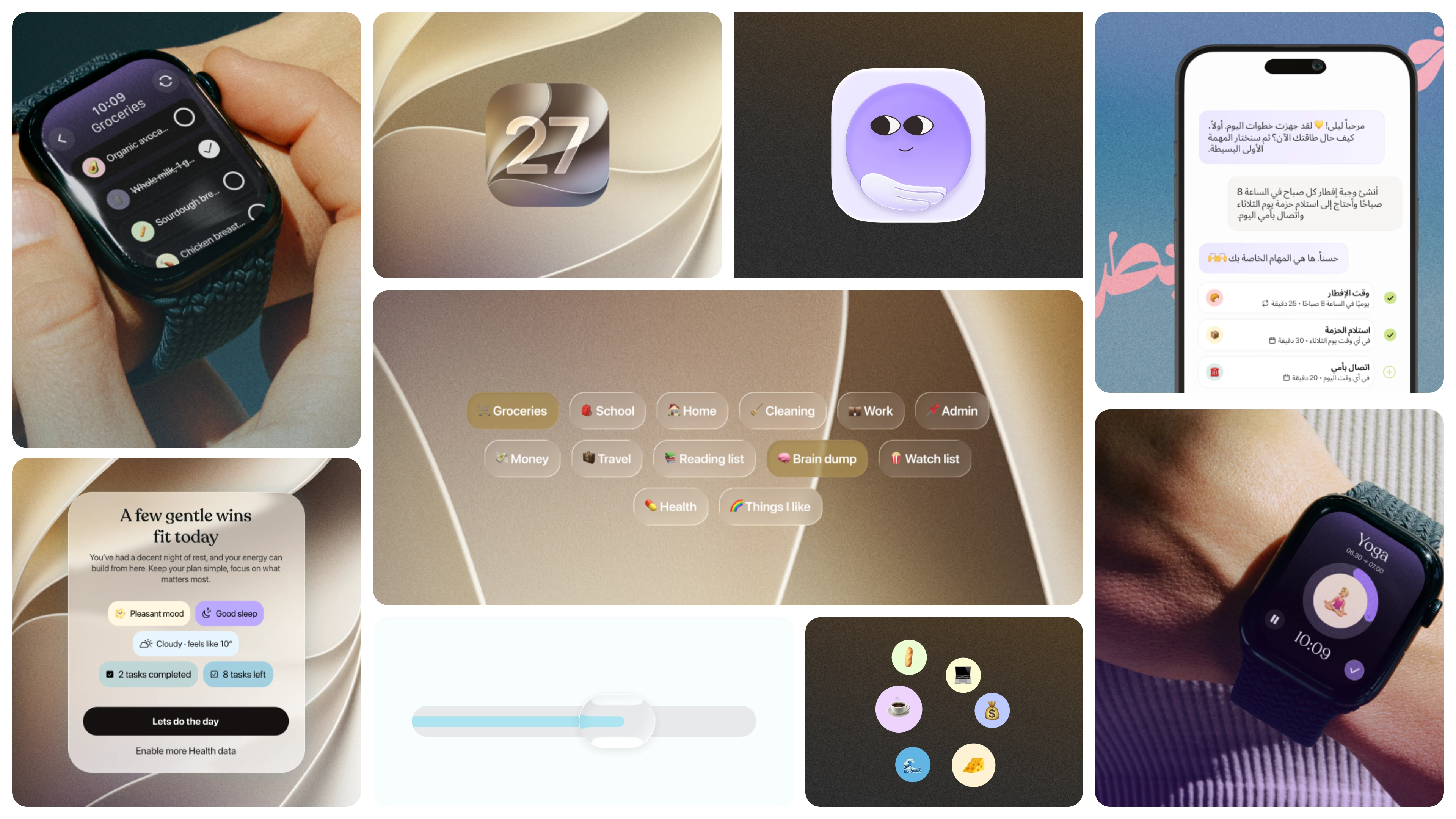
Siri integration, intelligent lists, snap to plans, and XL widgets. Here's everything Tiimo is bringing to iOS 27.
Five ADHD-friendly organization tips that reduce clutter and simplify cleaning.
