Energy management is for some people not a big issue. For others, they have to carefully look at their energy capacity and always plan ahead. The Spoon Theory helps you explain why there isn’t always enough energy in your inner account and helps you plan with more clarity.
No items found.
You know those people who seem to juggle work, family, and workouts with one effortless breath. From the outside, it looks like saying yes and no comes naturally to them. Meanwhile, you might feel unfulfilled, wondering why you can have plenty of energy Monday at 10, but by Thursday afternoon you could honestly nap until Sunday. You try opening up to your friends about the challenges you’re facing. They ask things like: Why don’t you structure better? Why don’t you say no? And suddenly you’re stuck between your intention to handle the week like everyone else and the reality that it’s hard to explain why regulating your inner battery feels so unpredictable.
One helpful part is that you’re not alone. And nothing about this makes you broken. It just means you’re working with a different kind of energy system.
Let’s take a look at a simple method to balance your energy and explain to your friend circle why you some days feel drained.
The Spoon Theory is born
Back in 2003 writer Christine Miserandino was facing the same issue explaining why she sometimes felt exhausted due to her chronic condition, Lupus, an autoimmune disease that causes widespread inflammation and tissue damage.
She was in a diner with her best friend from college, chatting about everything and nothing.
Her friend suddenly asked her how it feels to be sick with lupus. At first Christine Miserandino rambled about pills, pain, and the medical definition of Lupus. But that was not the answer her best friend was looking for. She wanted to know how it really feels to be chronically sick. Not just physically.
At first, Christine Miserandino couldn’t give her a straightforward answer. She needed something more tangible to describe her situation. That day she developed the Spoon Theory and later described it in a personal essay.
Let's dive into the Spoon Theory.
12 spoons to cover your day
Christine Miserandino grabbed a handful of spoons from the table at the diner and handed them to her friend, asking her to count them. There were 12 in her hand. Her friend was puzzled. Christine explained that a healthy person expects to have a never-ending supply of “spoons”.
“But when you have to now plan your day, you need to know exactly how many “spoons” you are starting with,” she wrote in the essay.
Each spoon represents the energy a person needs for a task. Twelve spoons are meant to cover a full day from early morning to late night. Each task takes a spoon. Getting up, one spoon is gone. Eating breakfast, another spoon is gone. And it continues like that throughout the day. Christine’s friend had to choose wisely how those 12 energy spoons should be used.
If she, for example, used a spoon on cleaning the kitchen after dinner, she couldn’t run errands in the afternoon. She suddenly realised that there weren’t enough spoons for everything she wanted to do.
That day at the diner, Christine’s friend finally understood the challenges of living with a chronic condition and the ongoing work of balancing energy.
Build momentum. Follow through. Get things done.
Tiimo helps you start, stay focused, and stick with it, using visual timelines, realistic routines, and tools that turn effort into progress.
Given this limited supply of energy, people with fewer spoons must carefully manage their day. They may need to prioritize essential tasks over social activities, work commitments or exercise. They may need to plan rest breaks and pace themselves to avoid running out of spoons too early. If they exhaust their spoons, they might not have the energy to do anything else.
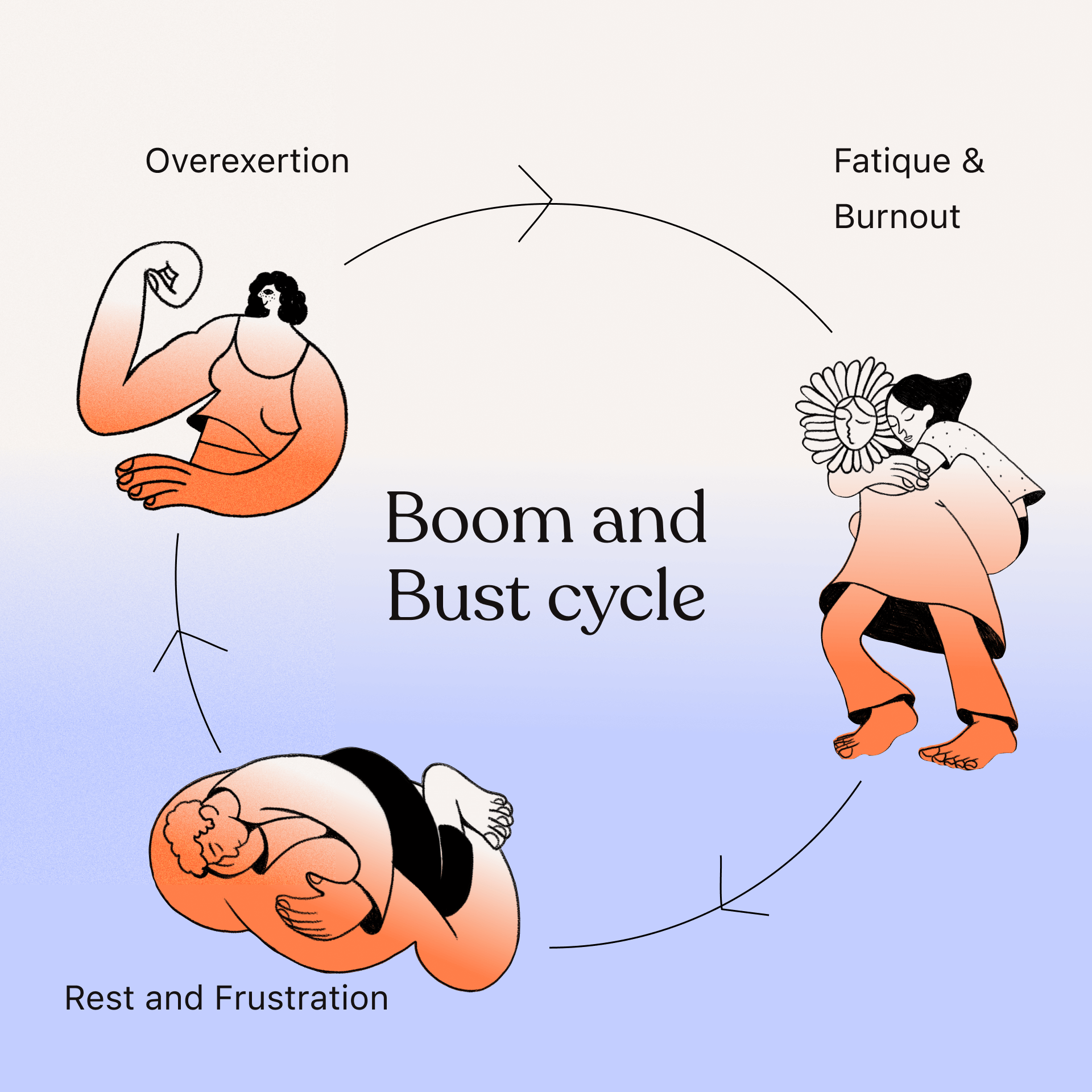
The Boom and Bust cycle is caused by pushing past what your spoons can support.
But why is it so hard to structure your 12 spoons to have a balanced life? Maybe you are using all of your spoons all at once and falling into a cycle of Boom and Bust. Let’s first take a look at that.
If you’re experiencing issues with regulating your inner battery and have a tendency to overextend yourself when things feel good, and later need extra recovery time, then you’re likely in a never-ending Boom and Bust cycle.
Neurodivergent psychologist Dr. Megan Anna Neff explains why this can turn into a vicious cycle on her website:
”As ADHDers and Autistic people, we often overextend ourselves–failing to honor our limits in our effort to “push through.” Inevitably, we crash (aka: burnout), then the cycle starts all over again. Rinse and repeat. And each time we whirl through this cycle, we sink ourselves deeper and deeper into burnout.”
That’s why it’s essential to take a good look at your spoons. It’s not a viable situation when you spend Saturday on a roll with 12 spoons in your pocket and dance all night, then feel tired and overwhelmed already on Monday, and spend the rest of the week feeling frustrated and surviving on three spoons.
How to find your own 12 spoons
Now you are ready to find your own set of spoons.
Here's how you go about it:
Find a cozy place to sit where you’re not easily distracted.
Grab three post-its and write Morning, Day, and Evening.
Then use some smaller post-its, maybe in another color, and write down all your tasks, both small and big. Each of your tasks represents a spoon.
Then the energy mapping begins. Tell yourself that you have only 12 spoons, and you have to decide how to use them throughout the day.
Maybe some of your daily tasks feel easy to get through, but in the bigger spoon budget, they still count. You might be surprised when you realise that 12 spoons isn’t a lot on a daily basis. Some tasks are represented by one spoon, while others, for example grocery shopping, can take away two or three spoons.
When you’re done mapping, look at your spoons with curiosity. Then ask yourself: Do I repeat the Boom and Bust cycle over and over again? Do I use my 12 spoons wisely, or do I crash every week?
"For those with limited spoons, the theory is a crucial reminder to slow down and listen to their bodies. It can be difficult and disheartening to realize that you need to pace yourself while others don’t. But, it’s important to remember that there is no race to the finish line of a day; the goal is to complete what’s necessary without burning through your energy reserves. Taking breaks, saying no to unnecessary tasks and asking for help are all valid strategies to preserve spoons.” M. Travers, 2024
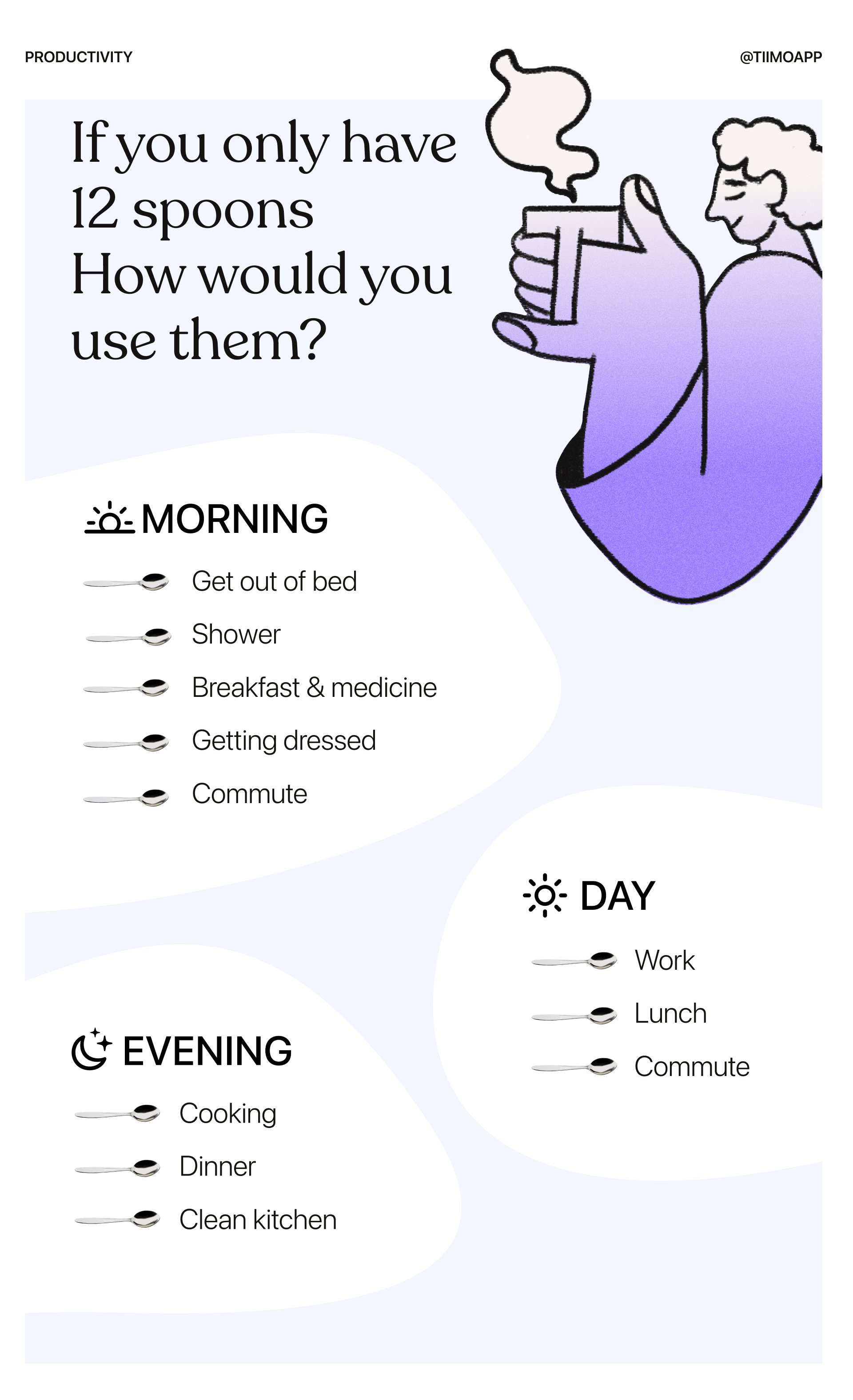
An example of how spoons can be evenly distributed across the day
Then try to reorder your spoons according to how much daily energy you have. Maybe you’ll find out that some tasks, like seeing close friends, actually give you energy, while others leave you drained on the floor. Try to mix and match and find a structure where you follow a draining task with an energising one.
It’s not easy, but it’s a step and a visual guideline to help you balance your life. And maybe you’ll discover that on some days, you can keep a spoon in reserve in your pocket, just in case something unplanned comes up.
FAQ
What is the Spoon Theory?
The Spoon Theory is a way to explain energy as a limited resource. Each spoon represents the energy needed for a task, helping people understand why they can’t do everything in one day.
Who is the Spoon Theory for?
The Spoon Theory was created to explain life with chronic illness, but it’s widely used by neurodivergent people, including ADHDers and Autistic people, to understand energy and burnout.
What is the Boom and Bust cycle?
The Boom and Bust cycle happens when you use too much energy on good days and then need extended recovery afterward. Over time, this pattern can lead to burnout.
How many spoons do I have in a day?
The number of spoons varies from person to person and day to day. Twelve spoons is a helpful metaphor, not a rule.
How can the Spoon Theory help with burnout?
By making energy visible, the Spoon Theory helps people pace themselves, plan rest, and avoid overextending their energy.
Mette is a communications and content intern at Tiimo, where she helps craft clear, inclusive messaging and user-friendly experiences for neurodivergent audiences.
Energy management is for some people not a big issue. For others, they have to carefully look at their energy capacity and always plan ahead. The Spoon Theory helps you explain why there isn’t always enough energy in your inner account and helps you plan with more clarity.
No items found.
You know those people who seem to juggle work, family, and workouts with one effortless breath. From the outside, it looks like saying yes and no comes naturally to them. Meanwhile, you might feel unfulfilled, wondering why you can have plenty of energy Monday at 10, but by Thursday afternoon you could honestly nap until Sunday. You try opening up to your friends about the challenges you’re facing. They ask things like: Why don’t you structure better? Why don’t you say no? And suddenly you’re stuck between your intention to handle the week like everyone else and the reality that it’s hard to explain why regulating your inner battery feels so unpredictable.
One helpful part is that you’re not alone. And nothing about this makes you broken. It just means you’re working with a different kind of energy system.
Let’s take a look at a simple method to balance your energy and explain to your friend circle why you some days feel drained.
The Spoon Theory is born
Back in 2003 writer Christine Miserandino was facing the same issue explaining why she sometimes felt exhausted due to her chronic condition, Lupus, an autoimmune disease that causes widespread inflammation and tissue damage.
She was in a diner with her best friend from college, chatting about everything and nothing.
Her friend suddenly asked her how it feels to be sick with lupus. At first Christine Miserandino rambled about pills, pain, and the medical definition of Lupus. But that was not the answer her best friend was looking for. She wanted to know how it really feels to be chronically sick. Not just physically.
At first, Christine Miserandino couldn’t give her a straightforward answer. She needed something more tangible to describe her situation. That day she developed the Spoon Theory and later described it in a personal essay.
Let's dive into the Spoon Theory.
12 spoons to cover your day
Christine Miserandino grabbed a handful of spoons from the table at the diner and handed them to her friend, asking her to count them. There were 12 in her hand. Her friend was puzzled. Christine explained that a healthy person expects to have a never-ending supply of “spoons”.
“But when you have to now plan your day, you need to know exactly how many “spoons” you are starting with,” she wrote in the essay.
Each spoon represents the energy a person needs for a task. Twelve spoons are meant to cover a full day from early morning to late night. Each task takes a spoon. Getting up, one spoon is gone. Eating breakfast, another spoon is gone. And it continues like that throughout the day. Christine’s friend had to choose wisely how those 12 energy spoons should be used.
If she, for example, used a spoon on cleaning the kitchen after dinner, she couldn’t run errands in the afternoon. She suddenly realised that there weren’t enough spoons for everything she wanted to do.
That day at the diner, Christine’s friend finally understood the challenges of living with a chronic condition and the ongoing work of balancing energy.
Build momentum. Follow through. Get things done.
Tiimo helps you start, stay focused, and stick with it, using visual timelines, realistic routines, and tools that turn effort into progress.
Given this limited supply of energy, people with fewer spoons must carefully manage their day. They may need to prioritize essential tasks over social activities, work commitments or exercise. They may need to plan rest breaks and pace themselves to avoid running out of spoons too early. If they exhaust their spoons, they might not have the energy to do anything else.
The Boom and Bust cycle is caused by pushing past what your spoons can support.
But why is it so hard to structure your 12 spoons to have a balanced life? Maybe you are using all of your spoons all at once and falling into a cycle of Boom and Bust. Let’s first take a look at that.
If you’re experiencing issues with regulating your inner battery and have a tendency to overextend yourself when things feel good, and later need extra recovery time, then you’re likely in a never-ending Boom and Bust cycle.
Neurodivergent psychologist Dr. Megan Anna Neff explains why this can turn into a vicious cycle on her website:
”As ADHDers and Autistic people, we often overextend ourselves–failing to honor our limits in our effort to “push through.” Inevitably, we crash (aka: burnout), then the cycle starts all over again. Rinse and repeat. And each time we whirl through this cycle, we sink ourselves deeper and deeper into burnout.”
That’s why it’s essential to take a good look at your spoons. It’s not a viable situation when you spend Saturday on a roll with 12 spoons in your pocket and dance all night, then feel tired and overwhelmed already on Monday, and spend the rest of the week feeling frustrated and surviving on three spoons.
How to find your own 12 spoons
Now you are ready to find your own set of spoons.
Here's how you go about it:
Find a cozy place to sit where you’re not easily distracted.
Grab three post-its and write Morning, Day, and Evening.
Then use some smaller post-its, maybe in another color, and write down all your tasks, both small and big. Each of your tasks represents a spoon.
Then the energy mapping begins. Tell yourself that you have only 12 spoons, and you have to decide how to use them throughout the day.
Maybe some of your daily tasks feel easy to get through, but in the bigger spoon budget, they still count. You might be surprised when you realise that 12 spoons isn’t a lot on a daily basis. Some tasks are represented by one spoon, while others, for example grocery shopping, can take away two or three spoons.
When you’re done mapping, look at your spoons with curiosity. Then ask yourself: Do I repeat the Boom and Bust cycle over and over again? Do I use my 12 spoons wisely, or do I crash every week?
"For those with limited spoons, the theory is a crucial reminder to slow down and listen to their bodies. It can be difficult and disheartening to realize that you need to pace yourself while others don’t. But, it’s important to remember that there is no race to the finish line of a day; the goal is to complete what’s necessary without burning through your energy reserves. Taking breaks, saying no to unnecessary tasks and asking for help are all valid strategies to preserve spoons.” M. Travers, 2024
An example of how spoons can be evenly distributed across the day
Then try to reorder your spoons according to how much daily energy you have. Maybe you’ll find out that some tasks, like seeing close friends, actually give you energy, while others leave you drained on the floor. Try to mix and match and find a structure where you follow a draining task with an energising one.
It’s not easy, but it’s a step and a visual guideline to help you balance your life. And maybe you’ll discover that on some days, you can keep a spoon in reserve in your pocket, just in case something unplanned comes up.
FAQ
What is the Spoon Theory?
The Spoon Theory is a way to explain energy as a limited resource. Each spoon represents the energy needed for a task, helping people understand why they can’t do everything in one day.
Who is the Spoon Theory for?
The Spoon Theory was created to explain life with chronic illness, but it’s widely used by neurodivergent people, including ADHDers and Autistic people, to understand energy and burnout.
What is the Boom and Bust cycle?
The Boom and Bust cycle happens when you use too much energy on good days and then need extended recovery afterward. Over time, this pattern can lead to burnout.
How many spoons do I have in a day?
The number of spoons varies from person to person and day to day. Twelve spoons is a helpful metaphor, not a rule.
How can the Spoon Theory help with burnout?
By making energy visible, the Spoon Theory helps people pace themselves, plan rest, and avoid overextending their energy.
Mette is a communications and content intern at Tiimo, where she helps craft clear, inclusive messaging and user-friendly experiences for neurodivergent audiences.
Energy management is for some people not a big issue. For others, they have to carefully look at their energy capacity and always plan ahead. The Spoon Theory helps you explain why there isn’t always enough energy in your inner account and helps you plan with more clarity.
Georgina Shute
Gina is an ADHD coach and founder of KindTwo, helping overwhelmed leaders reclaim time and build neuroinclusive systems that actually work.
No items found.
You know those people who seem to juggle work, family, and workouts with one effortless breath. From the outside, it looks like saying yes and no comes naturally to them. Meanwhile, you might feel unfulfilled, wondering why you can have plenty of energy Monday at 10, but by Thursday afternoon you could honestly nap until Sunday. You try opening up to your friends about the challenges you’re facing. They ask things like: Why don’t you structure better? Why don’t you say no? And suddenly you’re stuck between your intention to handle the week like everyone else and the reality that it’s hard to explain why regulating your inner battery feels so unpredictable.
One helpful part is that you’re not alone. And nothing about this makes you broken. It just means you’re working with a different kind of energy system.
Let’s take a look at a simple method to balance your energy and explain to your friend circle why you some days feel drained.
The Spoon Theory is born
Back in 2003 writer Christine Miserandino was facing the same issue explaining why she sometimes felt exhausted due to her chronic condition, Lupus, an autoimmune disease that causes widespread inflammation and tissue damage.
She was in a diner with her best friend from college, chatting about everything and nothing.
Her friend suddenly asked her how it feels to be sick with lupus. At first Christine Miserandino rambled about pills, pain, and the medical definition of Lupus. But that was not the answer her best friend was looking for. She wanted to know how it really feels to be chronically sick. Not just physically.
At first, Christine Miserandino couldn’t give her a straightforward answer. She needed something more tangible to describe her situation. That day she developed the Spoon Theory and later described it in a personal essay.
Let's dive into the Spoon Theory.
12 spoons to cover your day
Christine Miserandino grabbed a handful of spoons from the table at the diner and handed them to her friend, asking her to count them. There were 12 in her hand. Her friend was puzzled. Christine explained that a healthy person expects to have a never-ending supply of “spoons”.
“But when you have to now plan your day, you need to know exactly how many “spoons” you are starting with,” she wrote in the essay.
Each spoon represents the energy a person needs for a task. Twelve spoons are meant to cover a full day from early morning to late night. Each task takes a spoon. Getting up, one spoon is gone. Eating breakfast, another spoon is gone. And it continues like that throughout the day. Christine’s friend had to choose wisely how those 12 energy spoons should be used.
If she, for example, used a spoon on cleaning the kitchen after dinner, she couldn’t run errands in the afternoon. She suddenly realised that there weren’t enough spoons for everything she wanted to do.
That day at the diner, Christine’s friend finally understood the challenges of living with a chronic condition and the ongoing work of balancing energy.
Given this limited supply of energy, people with fewer spoons must carefully manage their day. They may need to prioritize essential tasks over social activities, work commitments or exercise. They may need to plan rest breaks and pace themselves to avoid running out of spoons too early. If they exhaust their spoons, they might not have the energy to do anything else.
The Boom and Bust cycle is caused by pushing past what your spoons can support.
But why is it so hard to structure your 12 spoons to have a balanced life? Maybe you are using all of your spoons all at once and falling into a cycle of Boom and Bust. Let’s first take a look at that.
If you’re experiencing issues with regulating your inner battery and have a tendency to overextend yourself when things feel good, and later need extra recovery time, then you’re likely in a never-ending Boom and Bust cycle.
Neurodivergent psychologist Dr. Megan Anna Neff explains why this can turn into a vicious cycle on her website:
”As ADHDers and Autistic people, we often overextend ourselves–failing to honor our limits in our effort to “push through.” Inevitably, we crash (aka: burnout), then the cycle starts all over again. Rinse and repeat. And each time we whirl through this cycle, we sink ourselves deeper and deeper into burnout.”
That’s why it’s essential to take a good look at your spoons. It’s not a viable situation when you spend Saturday on a roll with 12 spoons in your pocket and dance all night, then feel tired and overwhelmed already on Monday, and spend the rest of the week feeling frustrated and surviving on three spoons.
How to find your own 12 spoons
Now you are ready to find your own set of spoons.
Here's how you go about it:
Find a cozy place to sit where you’re not easily distracted.
Grab three post-its and write Morning, Day, and Evening.
Then use some smaller post-its, maybe in another color, and write down all your tasks, both small and big. Each of your tasks represents a spoon.
Then the energy mapping begins. Tell yourself that you have only 12 spoons, and you have to decide how to use them throughout the day.
Maybe some of your daily tasks feel easy to get through, but in the bigger spoon budget, they still count. You might be surprised when you realise that 12 spoons isn’t a lot on a daily basis. Some tasks are represented by one spoon, while others, for example grocery shopping, can take away two or three spoons.
When you’re done mapping, look at your spoons with curiosity. Then ask yourself: Do I repeat the Boom and Bust cycle over and over again? Do I use my 12 spoons wisely, or do I crash every week?
"For those with limited spoons, the theory is a crucial reminder to slow down and listen to their bodies. It can be difficult and disheartening to realize that you need to pace yourself while others don’t. But, it’s important to remember that there is no race to the finish line of a day; the goal is to complete what’s necessary without burning through your energy reserves. Taking breaks, saying no to unnecessary tasks and asking for help are all valid strategies to preserve spoons.” M. Travers, 2024
An example of how spoons can be evenly distributed across the day
Then try to reorder your spoons according to how much daily energy you have. Maybe you’ll find out that some tasks, like seeing close friends, actually give you energy, while others leave you drained on the floor. Try to mix and match and find a structure where you follow a draining task with an energising one.
It’s not easy, but it’s a step and a visual guideline to help you balance your life. And maybe you’ll discover that on some days, you can keep a spoon in reserve in your pocket, just in case something unplanned comes up.
FAQ
What is the Spoon Theory?
The Spoon Theory is a way to explain energy as a limited resource. Each spoon represents the energy needed for a task, helping people understand why they can’t do everything in one day.
Who is the Spoon Theory for?
The Spoon Theory was created to explain life with chronic illness, but it’s widely used by neurodivergent people, including ADHDers and Autistic people, to understand energy and burnout.
What is the Boom and Bust cycle?
The Boom and Bust cycle happens when you use too much energy on good days and then need extended recovery afterward. Over time, this pattern can lead to burnout.
How many spoons do I have in a day?
The number of spoons varies from person to person and day to day. Twelve spoons is a helpful metaphor, not a rule.
How can the Spoon Theory help with burnout?
By making energy visible, the Spoon Theory helps people pace themselves, plan rest, and avoid overextending their energy.