Top three ADHD productivity tips for overwhelm
Three simple strategies to beat overwhelm: start with one small step, focus on a single task, and clear quick wins to build momentum.
No items found.


Three simple strategies to beat overwhelm: start with one small step, focus on a single task, and clear quick wins to build momentum.
You’re lying in bed looking at the pile of clothes on the chair, trying to remember what’s clean enough to wear again. The kitchen is a mess, there’s a library book you were supposed to return weeks ago, and every unfinished task in your life suddenly seems to exist in the same room at the same time. After a while, overwhelm starts turning into self-criticism. You tell yourself you’re lazy, messy, irresponsible, and bad at being an adult.
For a lot of neurodivergent people, daily life can start feeling overwhelming long before things look “that bad” from the outside (at which point you're likely in the throes of ADHD burnout). Once your brain is already carrying too many tabs at once, even simple tasks can feel weirdly difficult to begin, a feeling often referred to as ADHD task paralysis. Laundry turns into five different decisions. Replying to one message suddenly feels enormous. A cluttered room starts creating visual noise that your brain can’t tune out.
That’s why traditional productivity advice often falls flat for ADHDers. Being told to “just focus” or “be more disciplined” usually adds guilt without making tasks any easier to start. What tends to help more is lowering the pressure, reducing friction, and building systems that make starting feel manageable.
Here are three strategies that can help you make progress without immediately burning yourself out.
Ever looked at a task and felt frozen before you even started? ADHD paralysis is incredibly common for ADHDers because your brain often sees the entire project all at once. Instead of “do the laundry,” your brain starts calculating sorting clothes, finding detergent, starting the wash, remembering to move it later, folding everything, putting it away, and somehow reorganizing your entire life while you’re at it.
The Single Step strategy helps interrupt that spiral by asking one simple question: What’s the smallest, easiest action I can take right now?
The goal is to shrink the task down until your brain stops resisting it. Instead of focusing on the finished outcome, focus on the next visible action directly in front of you.
So you’re still in bed looking at the piles around the room. Normally, this is the point where your brain starts layering meaning onto the mess:
Instead of trying to solve the entire room at once, narrow the scope. Ask yourself what the smallest thing is that would make the situation feel even slightly easier.
Maybe that means:
Once that’s done, ask yourself the same question again. Maybe you can collect the clean clothes now. Maybe you start a wash. Maybe you stop there because that’s all you realistically have capacity for today.
What makes ADHD overwhelm so exhausting is that every task starts feeling emotionally loaded before it has even begun. Breaking things down into smaller actions gives your nervous system less to push against, which makes it easier to get moving in the first place.
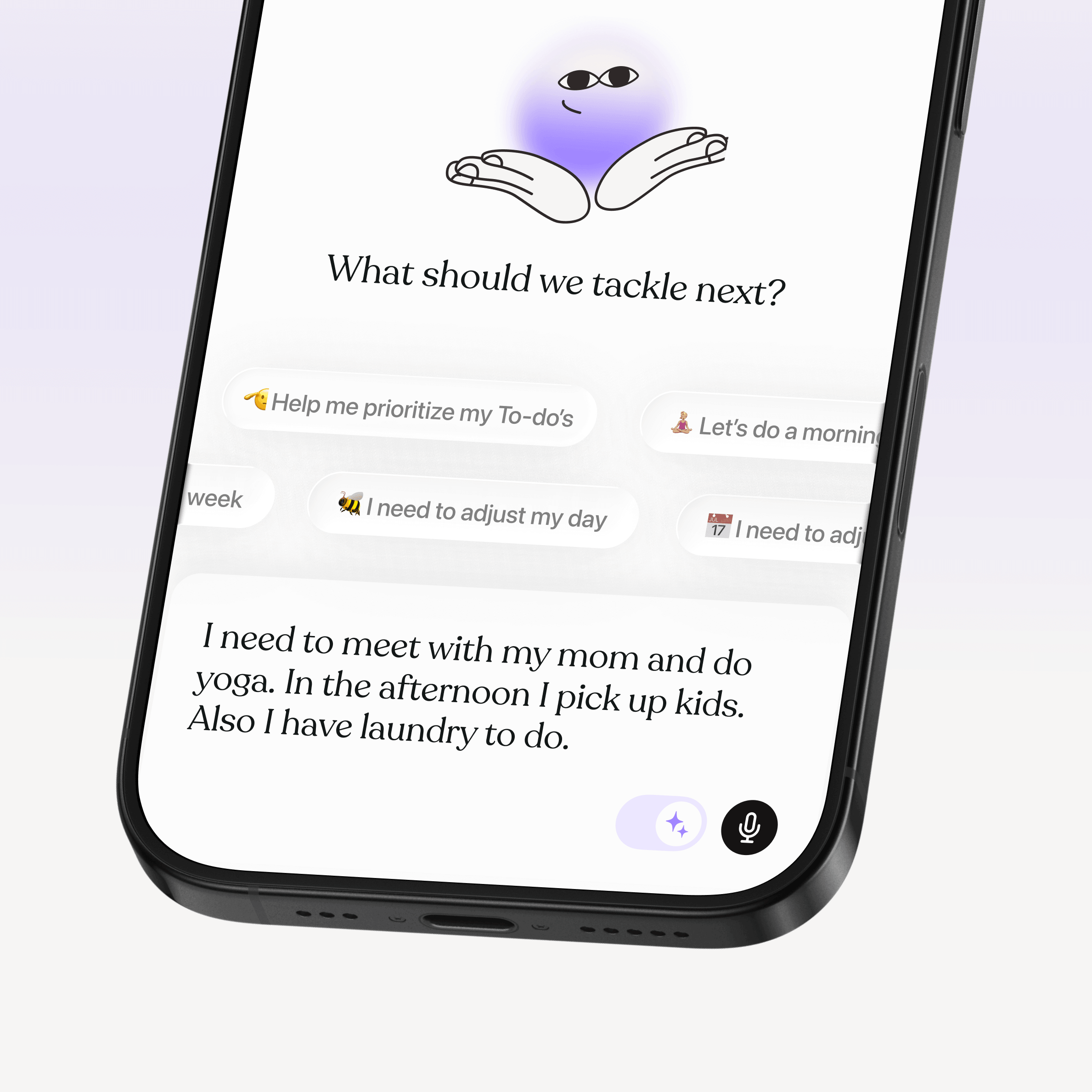
You can use the Single Step strategy in Tiimo with the AI Co-planner by dumping all the half-finished thoughts, reminders, and tasks currently taking up space in your head. Instead of leaving everything as a single, vague, overwhelming cloud, the Co-planner helps break tasks into smaller, more manageable actions with realistic time estimates, making it much easier to figure out where to begin.
Multitasking can feel productive in the moment, but for many ADHDers it creates more noise than momentum. You sit down to answer one email, remember another task halfway through, open a new tab to check something quickly, reply to a message while waiting for a page to load, and twenty minutes later, nothing actually got done.
The "Next Most Important Task" strategy works by giving your attention to one clear place to go for a limited amount of time, rather than trying to divide it across everything at once. The tricky part, of course, is that prioritizing can be genuinely difficult when everything feels equally urgent or equally impossible to start. If figuring out what to focus on feels like its own task, our guide to ADHD task prioritization can help make that process feel a little less overwhelming.
The goal here is not perfect concentration; your attention will still drift sometimes because you are a human being with a nervous system, not a machine. What actually helps is reducing the amount of competing input your brain is trying to manage all at once.
You sit down to work on a presentation. Before you begin, you quickly check Slack. A message reminds you about an email you forgot to answer, which makes you open your inbox, where you notice a calendar notification, which somehow turns into researching dinner recipes an hour later.
Instead, choose one clear task:
Your inbox, notifications, and random thoughts will still exist later. Right now, your brain only has one job.
Constant task-switching increases cognitive load, which is part of why ADHD brains often feel exhausted by the end of the day even when it seems like “nothing got done.” Every notification, unfinished task, open tab, and tiny decision pulls at your attention a little bit. Giving yourself permission to focus on one thing at a time can make work feel calmer, quieter, and much easier to stay inside of.
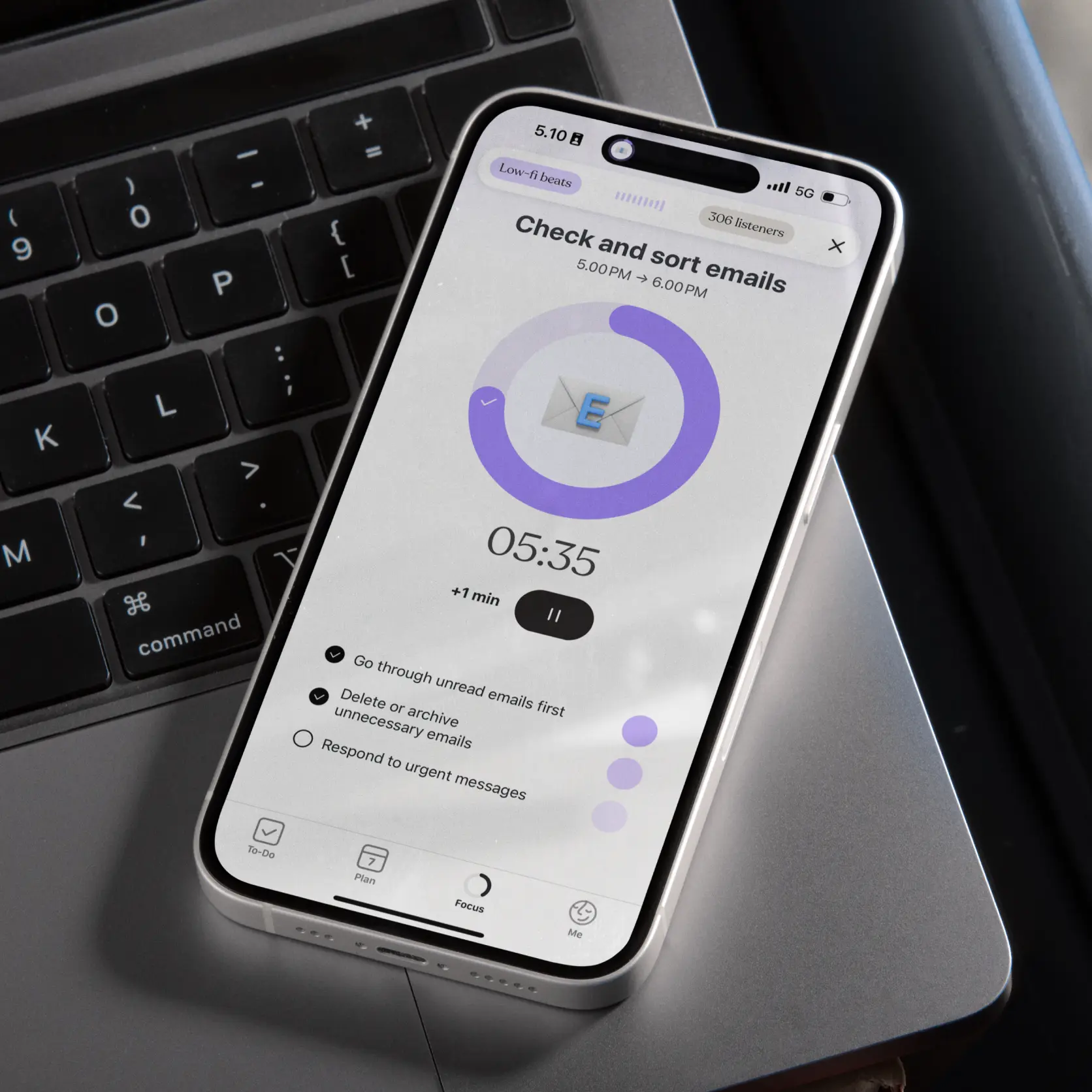
Tiimo’s focus timer can help create structure around single-task sessions by giving your brain a clear beginning and end point. Try creating a task called “Next Most Important Task” and assigning it a 45-minute focus session. If distractions are a challenge, adding a few setup subtasks beforehand can also help, like:
Small setup rituals reduce friction and make it easier to stay with the task once you’ve started.
Some of the smallest tasks are also the ones that quietly drain the most energy. Replying to a message, booking an appointment, returning an email, hanging up your jacket, refilling the Brita filter. Individually, they’re tiny, but when enough of them pile up, they create this constant low-level feeling that everything is unfinished. The Two-Minute Rule is simple: if something takes less than two minutes, do it while it’s already in front of you.
A lot of ADHD procrastination has less to do with the task itself and more to do with the invisible effort of reopening it over and over again in your brain. Every tiny unfinished task becomes another open tab competing for attention, which is part of why small admin tasks can feel weirdly exhausting.
And if you have a hard time estimating whether something will take two minutes or twenty, that’s normal. Many ADHD’ers experience time agnosia, which is the difficulty of accurately perceiving how long tasks will actually take, especially when they involve multiple steps or transitions. That’s where duration estimates can help. In Tiimo, adding estimated task lengths can make tasks feel more concrete, easier to approach, and less mentally ambiguous before you start.
Clearing tiny tasks quickly reduces background stress and frees up mental space for bigger things. It also creates momentum because finishing one thing often makes the next thing easier to begin.
A small daily “reset” block in Tiimo can work really well for this. Spend five or ten minutes scanning your to-do list, apartment, or inbox for quick wins you can knock out immediately. Over time, consistently clearing tiny tasks helps prevent them from quietly accumulating into the kind of mental clutter that can start feeling emotionally overwhelming.
ADHD overwhelm rarely appears all at once. More often, it builds quietly through unfinished tasks, constant context switching, decision fatigue, and the exhausting mental effort of trying to hold everything in your head at the same time. What starts as “I’ll do it later” slowly turns into a nervous system that already feels overloaded before the day has properly begun.
That’s why so much traditional productivity advice falls flat for ADHD’ers. Most systems assume you can seamlessly prioritize, transition between tasks, remember every detail, and make decisions all day without burning out, when in reality, even small choices and interruptions can steadily drain mental energy.
ADHD-friendly strategies tend to work better when they reduce friction and lower cognitive load. Smaller steps, fewer decisions, external reminders, visual systems, and simpler routines all help make tasks feel easier to start and easier to return to after distraction. Over time, those small adjustments can make daily life feel less chaotic, less mentally heavy, and far more manageable.

Three simple strategies to beat overwhelm: start with one small step, focus on a single task, and clear quick wins to build momentum.
You’re lying in bed looking at the pile of clothes on the chair, trying to remember what’s clean enough to wear again. The kitchen is a mess, there’s a library book you were supposed to return weeks ago, and every unfinished task in your life suddenly seems to exist in the same room at the same time. After a while, overwhelm starts turning into self-criticism. You tell yourself you’re lazy, messy, irresponsible, and bad at being an adult.
For a lot of neurodivergent people, daily life can start feeling overwhelming long before things look “that bad” from the outside (at which point you're likely in the throes of ADHD burnout). Once your brain is already carrying too many tabs at once, even simple tasks can feel weirdly difficult to begin, a feeling often referred to as ADHD task paralysis. Laundry turns into five different decisions. Replying to one message suddenly feels enormous. A cluttered room starts creating visual noise that your brain can’t tune out.
That’s why traditional productivity advice often falls flat for ADHDers. Being told to “just focus” or “be more disciplined” usually adds guilt without making tasks any easier to start. What tends to help more is lowering the pressure, reducing friction, and building systems that make starting feel manageable.
Here are three strategies that can help you make progress without immediately burning yourself out.
Ever looked at a task and felt frozen before you even started? ADHD paralysis is incredibly common for ADHDers because your brain often sees the entire project all at once. Instead of “do the laundry,” your brain starts calculating sorting clothes, finding detergent, starting the wash, remembering to move it later, folding everything, putting it away, and somehow reorganizing your entire life while you’re at it.
The Single Step strategy helps interrupt that spiral by asking one simple question: What’s the smallest, easiest action I can take right now?
The goal is to shrink the task down until your brain stops resisting it. Instead of focusing on the finished outcome, focus on the next visible action directly in front of you.
So you’re still in bed looking at the piles around the room. Normally, this is the point where your brain starts layering meaning onto the mess:
Instead of trying to solve the entire room at once, narrow the scope. Ask yourself what the smallest thing is that would make the situation feel even slightly easier.
Maybe that means:
Once that’s done, ask yourself the same question again. Maybe you can collect the clean clothes now. Maybe you start a wash. Maybe you stop there because that’s all you realistically have capacity for today.
What makes ADHD overwhelm so exhausting is that every task starts feeling emotionally loaded before it has even begun. Breaking things down into smaller actions gives your nervous system less to push against, which makes it easier to get moving in the first place.
You can use the Single Step strategy in Tiimo with the AI Co-planner by dumping all the half-finished thoughts, reminders, and tasks currently taking up space in your head. Instead of leaving everything as a single, vague, overwhelming cloud, the Co-planner helps break tasks into smaller, more manageable actions with realistic time estimates, making it much easier to figure out where to begin.
Multitasking can feel productive in the moment, but for many ADHDers it creates more noise than momentum. You sit down to answer one email, remember another task halfway through, open a new tab to check something quickly, reply to a message while waiting for a page to load, and twenty minutes later, nothing actually got done.
The "Next Most Important Task" strategy works by giving your attention to one clear place to go for a limited amount of time, rather than trying to divide it across everything at once. The tricky part, of course, is that prioritizing can be genuinely difficult when everything feels equally urgent or equally impossible to start. If figuring out what to focus on feels like its own task, our guide to ADHD task prioritization can help make that process feel a little less overwhelming.
The goal here is not perfect concentration; your attention will still drift sometimes because you are a human being with a nervous system, not a machine. What actually helps is reducing the amount of competing input your brain is trying to manage all at once.
You sit down to work on a presentation. Before you begin, you quickly check Slack. A message reminds you about an email you forgot to answer, which makes you open your inbox, where you notice a calendar notification, which somehow turns into researching dinner recipes an hour later.
Instead, choose one clear task:
Your inbox, notifications, and random thoughts will still exist later. Right now, your brain only has one job.
Constant task-switching increases cognitive load, which is part of why ADHD brains often feel exhausted by the end of the day even when it seems like “nothing got done.” Every notification, unfinished task, open tab, and tiny decision pulls at your attention a little bit. Giving yourself permission to focus on one thing at a time can make work feel calmer, quieter, and much easier to stay inside of.
Tiimo’s focus timer can help create structure around single-task sessions by giving your brain a clear beginning and end point. Try creating a task called “Next Most Important Task” and assigning it a 45-minute focus session. If distractions are a challenge, adding a few setup subtasks beforehand can also help, like:
Small setup rituals reduce friction and make it easier to stay with the task once you’ve started.
Some of the smallest tasks are also the ones that quietly drain the most energy. Replying to a message, booking an appointment, returning an email, hanging up your jacket, refilling the Brita filter. Individually, they’re tiny, but when enough of them pile up, they create this constant low-level feeling that everything is unfinished. The Two-Minute Rule is simple: if something takes less than two minutes, do it while it’s already in front of you.
A lot of ADHD procrastination has less to do with the task itself and more to do with the invisible effort of reopening it over and over again in your brain. Every tiny unfinished task becomes another open tab competing for attention, which is part of why small admin tasks can feel weirdly exhausting.
And if you have a hard time estimating whether something will take two minutes or twenty, that’s normal. Many ADHD’ers experience time agnosia, which is the difficulty of accurately perceiving how long tasks will actually take, especially when they involve multiple steps or transitions. That’s where duration estimates can help. In Tiimo, adding estimated task lengths can make tasks feel more concrete, easier to approach, and less mentally ambiguous before you start.
Clearing tiny tasks quickly reduces background stress and frees up mental space for bigger things. It also creates momentum because finishing one thing often makes the next thing easier to begin.
A small daily “reset” block in Tiimo can work really well for this. Spend five or ten minutes scanning your to-do list, apartment, or inbox for quick wins you can knock out immediately. Over time, consistently clearing tiny tasks helps prevent them from quietly accumulating into the kind of mental clutter that can start feeling emotionally overwhelming.
ADHD overwhelm rarely appears all at once. More often, it builds quietly through unfinished tasks, constant context switching, decision fatigue, and the exhausting mental effort of trying to hold everything in your head at the same time. What starts as “I’ll do it later” slowly turns into a nervous system that already feels overloaded before the day has properly begun.
That’s why so much traditional productivity advice falls flat for ADHD’ers. Most systems assume you can seamlessly prioritize, transition between tasks, remember every detail, and make decisions all day without burning out, when in reality, even small choices and interruptions can steadily drain mental energy.
ADHD-friendly strategies tend to work better when they reduce friction and lower cognitive load. Smaller steps, fewer decisions, external reminders, visual systems, and simpler routines all help make tasks feel easier to start and easier to return to after distraction. Over time, those small adjustments can make daily life feel less chaotic, less mentally heavy, and far more manageable.
Three simple strategies to beat overwhelm: start with one small step, focus on a single task, and clear quick wins to build momentum.


You’re lying in bed looking at the pile of clothes on the chair, trying to remember what’s clean enough to wear again. The kitchen is a mess, there’s a library book you were supposed to return weeks ago, and every unfinished task in your life suddenly seems to exist in the same room at the same time. After a while, overwhelm starts turning into self-criticism. You tell yourself you’re lazy, messy, irresponsible, and bad at being an adult.
For a lot of neurodivergent people, daily life can start feeling overwhelming long before things look “that bad” from the outside (at which point you're likely in the throes of ADHD burnout). Once your brain is already carrying too many tabs at once, even simple tasks can feel weirdly difficult to begin, a feeling often referred to as ADHD task paralysis. Laundry turns into five different decisions. Replying to one message suddenly feels enormous. A cluttered room starts creating visual noise that your brain can’t tune out.
That’s why traditional productivity advice often falls flat for ADHDers. Being told to “just focus” or “be more disciplined” usually adds guilt without making tasks any easier to start. What tends to help more is lowering the pressure, reducing friction, and building systems that make starting feel manageable.
Here are three strategies that can help you make progress without immediately burning yourself out.
Ever looked at a task and felt frozen before you even started? ADHD paralysis is incredibly common for ADHDers because your brain often sees the entire project all at once. Instead of “do the laundry,” your brain starts calculating sorting clothes, finding detergent, starting the wash, remembering to move it later, folding everything, putting it away, and somehow reorganizing your entire life while you’re at it.
The Single Step strategy helps interrupt that spiral by asking one simple question: What’s the smallest, easiest action I can take right now?
The goal is to shrink the task down until your brain stops resisting it. Instead of focusing on the finished outcome, focus on the next visible action directly in front of you.
So you’re still in bed looking at the piles around the room. Normally, this is the point where your brain starts layering meaning onto the mess:
Instead of trying to solve the entire room at once, narrow the scope. Ask yourself what the smallest thing is that would make the situation feel even slightly easier.
Maybe that means:
Once that’s done, ask yourself the same question again. Maybe you can collect the clean clothes now. Maybe you start a wash. Maybe you stop there because that’s all you realistically have capacity for today.
What makes ADHD overwhelm so exhausting is that every task starts feeling emotionally loaded before it has even begun. Breaking things down into smaller actions gives your nervous system less to push against, which makes it easier to get moving in the first place.
You can use the Single Step strategy in Tiimo with the AI Co-planner by dumping all the half-finished thoughts, reminders, and tasks currently taking up space in your head. Instead of leaving everything as a single, vague, overwhelming cloud, the Co-planner helps break tasks into smaller, more manageable actions with realistic time estimates, making it much easier to figure out where to begin.
Multitasking can feel productive in the moment, but for many ADHDers it creates more noise than momentum. You sit down to answer one email, remember another task halfway through, open a new tab to check something quickly, reply to a message while waiting for a page to load, and twenty minutes later, nothing actually got done.
The "Next Most Important Task" strategy works by giving your attention to one clear place to go for a limited amount of time, rather than trying to divide it across everything at once. The tricky part, of course, is that prioritizing can be genuinely difficult when everything feels equally urgent or equally impossible to start. If figuring out what to focus on feels like its own task, our guide to ADHD task prioritization can help make that process feel a little less overwhelming.
The goal here is not perfect concentration; your attention will still drift sometimes because you are a human being with a nervous system, not a machine. What actually helps is reducing the amount of competing input your brain is trying to manage all at once.
You sit down to work on a presentation. Before you begin, you quickly check Slack. A message reminds you about an email you forgot to answer, which makes you open your inbox, where you notice a calendar notification, which somehow turns into researching dinner recipes an hour later.
Instead, choose one clear task:
Your inbox, notifications, and random thoughts will still exist later. Right now, your brain only has one job.
Constant task-switching increases cognitive load, which is part of why ADHD brains often feel exhausted by the end of the day even when it seems like “nothing got done.” Every notification, unfinished task, open tab, and tiny decision pulls at your attention a little bit. Giving yourself permission to focus on one thing at a time can make work feel calmer, quieter, and much easier to stay inside of.
Tiimo’s focus timer can help create structure around single-task sessions by giving your brain a clear beginning and end point. Try creating a task called “Next Most Important Task” and assigning it a 45-minute focus session. If distractions are a challenge, adding a few setup subtasks beforehand can also help, like:
Small setup rituals reduce friction and make it easier to stay with the task once you’ve started.
Some of the smallest tasks are also the ones that quietly drain the most energy. Replying to a message, booking an appointment, returning an email, hanging up your jacket, refilling the Brita filter. Individually, they’re tiny, but when enough of them pile up, they create this constant low-level feeling that everything is unfinished. The Two-Minute Rule is simple: if something takes less than two minutes, do it while it’s already in front of you.
A lot of ADHD procrastination has less to do with the task itself and more to do with the invisible effort of reopening it over and over again in your brain. Every tiny unfinished task becomes another open tab competing for attention, which is part of why small admin tasks can feel weirdly exhausting.
And if you have a hard time estimating whether something will take two minutes or twenty, that’s normal. Many ADHD’ers experience time agnosia, which is the difficulty of accurately perceiving how long tasks will actually take, especially when they involve multiple steps or transitions. That’s where duration estimates can help. In Tiimo, adding estimated task lengths can make tasks feel more concrete, easier to approach, and less mentally ambiguous before you start.
Clearing tiny tasks quickly reduces background stress and frees up mental space for bigger things. It also creates momentum because finishing one thing often makes the next thing easier to begin.
A small daily “reset” block in Tiimo can work really well for this. Spend five or ten minutes scanning your to-do list, apartment, or inbox for quick wins you can knock out immediately. Over time, consistently clearing tiny tasks helps prevent them from quietly accumulating into the kind of mental clutter that can start feeling emotionally overwhelming.
ADHD overwhelm rarely appears all at once. More often, it builds quietly through unfinished tasks, constant context switching, decision fatigue, and the exhausting mental effort of trying to hold everything in your head at the same time. What starts as “I’ll do it later” slowly turns into a nervous system that already feels overloaded before the day has properly begun.
That’s why so much traditional productivity advice falls flat for ADHD’ers. Most systems assume you can seamlessly prioritize, transition between tasks, remember every detail, and make decisions all day without burning out, when in reality, even small choices and interruptions can steadily drain mental energy.
ADHD-friendly strategies tend to work better when they reduce friction and lower cognitive load. Smaller steps, fewer decisions, external reminders, visual systems, and simpler routines all help make tasks feel easier to start and easier to return to after distraction. Over time, those small adjustments can make daily life feel less chaotic, less mentally heavy, and far more manageable.
When you're ready, try Tiimo and make structure a little easier.

Five ADHD-friendly organization tips that reduce clutter and simplify cleaning.

Why some ADHD'ers are diagnosed later in life and where to find support.
You’ve got plenty of energy, so why can’t you use it on the task that matters? Learn what blocks ADHD motivation and how to make difficult tasks easier to start.
