ADHD and energy management, explained
You’ve got plenty of energy, so why can’t you use it on the task that matters? Learn what blocks ADHD motivation and how to make difficult tasks easier to start.
No items found.


You’ve got plenty of energy, so why can’t you use it on the task that matters? Learn what blocks ADHD motivation and how to make difficult tasks easier to start.
You need to do your taxes. You know they matter, and you’ve been reminding yourself about them for so long that the reminder has practically become part of the furniture. You’ve got time and plenty of physical energy, but instead of opening the tax portal, you clean the drain pipes, which is how you end up hours later with an immaculate kitchen, a YouTube history suggesting you’re retraining as a plumber, and none of your taxes done.
That’s one of the more confusing parts of ADHD because, from the outside, it can look like a straightforward problem with procrastination or discipline. You were clearly capable of doing something, and quite a lot of it, so why couldn’t that energy be applied to the thing that mattered?
Because having energy and being able to direct it are different things: motivation has a direction as well as an intensity, and, with ADHD, that direction doesn’t reliably correspond with importance, consequences, or whatever you consciously decided to prioritize that morning. You can be restless, energetic, and extraordinarily productive while remaining unable to begin the two-minute task that’s been bothering you for three weeks. So, instead of asking yourself, “Why can’t I just do it?” try asking, “What’s making this particular task so difficult to approach?”
ADHD motivation is often discussed in relation to dopamine, a neurotransmitter involved in reward, attention, and the expectation that something will feel worthwhile. Differences in dopamine signaling and reward processing can make immediate feedback easier to act on than a distant or abstract payoff.
That helps explain why cleaning the drains can win against filing your taxes: the drains offer movement, visible progress, and a satisfying result, while taxes offer passwords, missing documents, and the prospect of confronting overspending or missed payments. One task keeps showing you that your effort is working; the other withholds its reward until it’s over.
The thing is, the longer you avoid a task, the more emotional weight it collects. A bill starts carrying fear about money, an unread message becomes evidence that you’ve let someone down, and a medical appointment comes to represent every health concern you’ve been avoiding. What began as a small piece of admin becomes tangled up with shame, and each day it goes undone, that shame compounds. Now you’re dealing with the task itself and the feeling that you should’ve completed it days or weeks ago. Urgency may eventually activate motivation, but by then the task feels far more threatening than it did to begin with.
But there's a reason piling on more pressure rarely helps. Self-determination theory suggests that motivation is easier to access when you have some choice, feel capable of what you’re being asked to do, and don’t feel alone in it; an overdue task can take all three away at once, as the deadline starts dictating your choices, the delay makes you doubt your ability, and embarrassment stops you from asking for help. Working out which part is making the task feel impossible gives you something more useful than another round of “Why haven’t I done this yet?”
Advice about task initiation often begins and ends with breaking the task into smaller pieces. That can help when a project contains so many hidden steps that your brain can’t locate an entrance, but size isn’t always the problem. Before trying to motivate yourself, work out what kind of stuck you’re dealing with.
“Sort out the house,” “work on the presentation,” and “get my life together” may sound like tasks, but they don’t tell your brain what to do with your hands, where to begin, or how you’ll know you’ve made progress. The task exists as a large, abstract outcome rather than a concrete action you can take.
You know how to begin, but starting feels like agreeing to continue until the entire problem has been solved. “I’ll clear out my inbox” translates into reading hundreds of messages, making dozens of decisions, and losing the rest of the afternoon, so your brain resists opening the first email. When you can’t see where a task ends, even the first step can feel like a much bigger commitment than it is.
You understand what to do, but you’re avoiding what the task could reveal or how it might make you feel. Checking your bank account could confront you with overspending, replying to a friend could bring up guilt about how long you’ve left it, and opening feedback from your manager could activate a fear that you’ve done something wrong. The practical steps may be simple, while the feelings attached to them are anything but.
Some tasks are clear, manageable, and emotionally neutral but so boring or repetitive that beginning feels disproportionately difficult. Folding laundry, entering expenses, unloading the dishwasher, or transferring information between spreadsheets may be straightforward, but they offer very little interest, visible progress, or immediate reward.
Sometimes the task isn’t the problem. A difficult email might feel manageable in the morning and impossible after a day of meetings because physical and cognitive energy aren’t interchangeable. Sleep difficulties, hormonal changes, anxiety, depression, chronic illness, medication effects, sensory overload, and ADHD burnout can all affect what you’re able to access on a given day.
Each strategy below targets one of those barriers; start with the closest match, or the easiest one to try if you can’t tell.
Reduce the task until you can picture the first physical action, using microtasks to lower the amount of information your brain has to hold before anything can happen.
For example:
“Start my taxes” is still too broad, whereas “find the email from my accountant” is specific enough to act on, following the same principle as SMART goals: the clearer and more concrete the next step, the easier it is to begin.
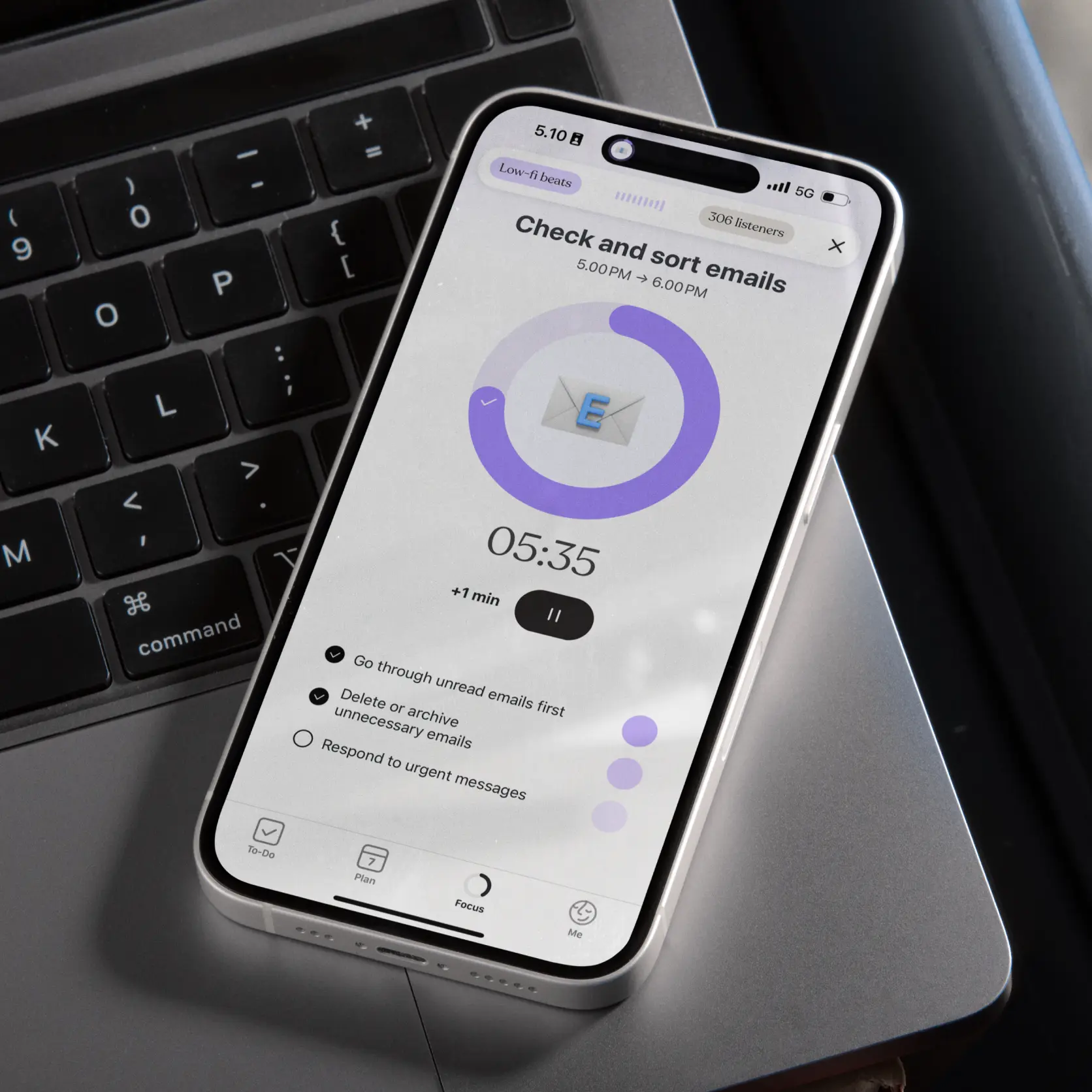
Tiimo tip: If a task still doesn’t feel specific enough, use Suggest Breakdown in Tiimo to turn it into a short list of subtasks, then edit the suggestions until the first step feels easy to start.
Decide how much you’re agreeing to do before you begin, so opening the first email doesn’t feel like surrendering the rest of the afternoon. Time blocking can help by giving the task a defined place in your day, particularly if time agnosia makes it difficult to estimate how long something will take or notice how much time has passed.
You might choose to:
The stopping point needs to mean what it says. If ten minutes secretly means “and then I have to continue until everything’s finished,” your brain will quickly learn that the promise can’t be trusted; you can always choose to continue when the block ends, but completing the amount you agreed to is already enough.
Tiimo tip: If you’re not sure how much time to set aside, let Tiimo suggest a duration for the task, or add a task alarm so you get a reminder when it’s time to start.
If you’re avoiding a task because of what you might find, how it could make you feel, or who you may have disappointed, limit the first step to finding out what you’re dealing with: open the bill without paying it, read the message without replying, or check your balance without creating a budget.
It can help to decide in advance what you won’t be asking yourself to do: “For the next five minutes, I’m only gathering information; I don’t have to make decisions or judge how I got here.”
Looking at a problem can feel impossible when it seems to commit you to solving everything immediately, whereas gathering the information first lowers the stakes and lets you see what the task actually requires.
A boring task may become easier to stay with when you add some of the movement, sensory input, or visible progress it’s missing.
Depending on the task, you might:
A personalized dopamine menu can help by giving you a ready-made list of things that support focus or momentum. It won’t make an insurance portal spiritually enriching, but the right amount of input can make it easier to begin and stay with the task.
You can also borrow momentum from something your brain already wants to do, although the bridge needs to be specific. “I’ll clean first and then do admin” leaves enough room to deep-clean the house, whereas “after I put the cleaning products away, I’ll open the tax email and read it once” gives that energy somewhere useful to go.
Tiimo tip: If visible progress helps you stay engaged, Tiimo Streaks turns completed tasks and sessions into trophies, giving you an immediate record of the effort you’ve made. Streaks are currently available on iOS only.
Physical and cognitive energy aren’t interchangeable, which is why you might have enough energy to walk the dog or reorganize the kitchen while writing an email feels impossible. Different tasks ask for different combinations of concentration, working memory, decision-making, and emotional regulation.
If your clearest mental energy tends to arrive in the morning, protect a small part of that window for something that requires it. You might open the form before checking social media, make the phone call while drinking your coffee, or choose the first microtask the night before so you don’t spend your best energy deciding where to begin.
On lower-capacity days, the useful version of a task may be smaller than usual, postponed until a better window, or done with more support. If your motivation has dropped across most areas of your life, including things you’d normally enjoy, it’s worth taking that change seriously and discussing it with a qualified healthcare professional.
Tiimo tip: Use Tiimo’s mood tracker to log how you feel alongside your schedule, so over time you can notice when your focus is strongest, which tasks drain you, and when it might make sense to plan a lighter day. The mood tracker is currently available on iOS only.
Even with the right strategy, there’ll be days when your brain refuses to cooperate, no matter how small you make the first step or how firmly you tell yourself that this time you’re definitely going to do it. Trying to bully yourself across the gap usually leaves you with the original task, the exhaustion of having fought yourself all day, and a fresh layer of guilt to carry into tomorrow.
There’s also a tendency to treat the task you intended to do as the only one that counts, which is how you can end a day with a clean kitchen, a walked dog, several answered emails, and food in the fridge, then call the whole thing a failure because you didn’t do your taxes. Even resting can feel like evidence that you’ve wasted the day, despite the obvious fact that a tired, hungry, overstimulated brain is unlikely to become more cooperative through further neglect.
If the task isn’t happening, it may be more useful to stop escalating the pressure and focus on leaving yourself in a better position to try again. A proper meal, enough water, your medication, some time outside, an earlier night, or asking someone to sit with you tomorrow may sound unrelated to the form, email, or phone call you’re avoiding, but all of them affect the brain you’re expecting to do it.
Sometimes managing your energy means accepting that today’s supply has gone elsewhere and making sure you refill it before asking for more. The difficult thing will still be there tomorrow, but you can return to it fed, rested, and without having spent the night building it into further proof that something’s wrong with you; and if the drains won today, the clean kitchen still counts.
ADDA Editorial Team. “ADHD and Motivation: 10 Productivity Hacks for Adults with ADHD.” Attention Deficit Disorder Association, 17 Oct. 2022, https://add.org/adhd-motivation/.
Champ, Rebecca E., Marios Adamou, and Barry Tolchard. “Seeking Connection, Autonomy, and Emotional Feedback: A Self-Determination Theory of Self-Regulation in Attention-Deficit Hyperactivity Disorder.” Psychological Review, vol. 130, no. 3, 2023, pp. 569–603. https://doi.org/10.1037/rev0000398.
Children and Adults with Attention-Deficit/Hyperactivity Disorder. “ADHD and Sleep Disorders.” CHADD, https://chadd.org/about-adhd/adhd-and-sleep-disorders/. Accessed 23 July 2026.
Mette, Christian. “Time Perception in Adult ADHD: Findings from a Decade—A Review.” International Journal of Environmental Research and Public Health, vol. 20, no. 4, 2023, article 3098. https://doi.org/10.3390/ijerph20043098.
Oflazian, J. S., and A. M. Borders. “Does Rumination Mediate the Unique Effects of Shame and Guilt on Procrastination?” Journal of Rational-Emotive & Cognitive-Behavior Therapy, vol. 41, no. 1, 2023, pp. 237–246. https://doi.org/10.1007/s10942-022-00466-y.
Osianlis, Elyssa, et al. “ADHD and Sex Hormones in Females: A Systematic Review.” Journal of Attention Disorders, vol. 29, no. 9, 2025, pp. 706–723. https://doi.org/10.1177/10870547251332319.

You’ve got plenty of energy, so why can’t you use it on the task that matters? Learn what blocks ADHD motivation and how to make difficult tasks easier to start.
You need to do your taxes. You know they matter, and you’ve been reminding yourself about them for so long that the reminder has practically become part of the furniture. You’ve got time and plenty of physical energy, but instead of opening the tax portal, you clean the drain pipes, which is how you end up hours later with an immaculate kitchen, a YouTube history suggesting you’re retraining as a plumber, and none of your taxes done.
That’s one of the more confusing parts of ADHD because, from the outside, it can look like a straightforward problem with procrastination or discipline. You were clearly capable of doing something, and quite a lot of it, so why couldn’t that energy be applied to the thing that mattered?
Because having energy and being able to direct it are different things: motivation has a direction as well as an intensity, and, with ADHD, that direction doesn’t reliably correspond with importance, consequences, or whatever you consciously decided to prioritize that morning. You can be restless, energetic, and extraordinarily productive while remaining unable to begin the two-minute task that’s been bothering you for three weeks. So, instead of asking yourself, “Why can’t I just do it?” try asking, “What’s making this particular task so difficult to approach?”
ADHD motivation is often discussed in relation to dopamine, a neurotransmitter involved in reward, attention, and the expectation that something will feel worthwhile. Differences in dopamine signaling and reward processing can make immediate feedback easier to act on than a distant or abstract payoff.
That helps explain why cleaning the drains can win against filing your taxes: the drains offer movement, visible progress, and a satisfying result, while taxes offer passwords, missing documents, and the prospect of confronting overspending or missed payments. One task keeps showing you that your effort is working; the other withholds its reward until it’s over.
The thing is, the longer you avoid a task, the more emotional weight it collects. A bill starts carrying fear about money, an unread message becomes evidence that you’ve let someone down, and a medical appointment comes to represent every health concern you’ve been avoiding. What began as a small piece of admin becomes tangled up with shame, and each day it goes undone, that shame compounds. Now you’re dealing with the task itself and the feeling that you should’ve completed it days or weeks ago. Urgency may eventually activate motivation, but by then the task feels far more threatening than it did to begin with.
But there's a reason piling on more pressure rarely helps. Self-determination theory suggests that motivation is easier to access when you have some choice, feel capable of what you’re being asked to do, and don’t feel alone in it; an overdue task can take all three away at once, as the deadline starts dictating your choices, the delay makes you doubt your ability, and embarrassment stops you from asking for help. Working out which part is making the task feel impossible gives you something more useful than another round of “Why haven’t I done this yet?”
Advice about task initiation often begins and ends with breaking the task into smaller pieces. That can help when a project contains so many hidden steps that your brain can’t locate an entrance, but size isn’t always the problem. Before trying to motivate yourself, work out what kind of stuck you’re dealing with.
“Sort out the house,” “work on the presentation,” and “get my life together” may sound like tasks, but they don’t tell your brain what to do with your hands, where to begin, or how you’ll know you’ve made progress. The task exists as a large, abstract outcome rather than a concrete action you can take.
You know how to begin, but starting feels like agreeing to continue until the entire problem has been solved. “I’ll clear out my inbox” translates into reading hundreds of messages, making dozens of decisions, and losing the rest of the afternoon, so your brain resists opening the first email. When you can’t see where a task ends, even the first step can feel like a much bigger commitment than it is.
You understand what to do, but you’re avoiding what the task could reveal or how it might make you feel. Checking your bank account could confront you with overspending, replying to a friend could bring up guilt about how long you’ve left it, and opening feedback from your manager could activate a fear that you’ve done something wrong. The practical steps may be simple, while the feelings attached to them are anything but.
Some tasks are clear, manageable, and emotionally neutral but so boring or repetitive that beginning feels disproportionately difficult. Folding laundry, entering expenses, unloading the dishwasher, or transferring information between spreadsheets may be straightforward, but they offer very little interest, visible progress, or immediate reward.
Sometimes the task isn’t the problem. A difficult email might feel manageable in the morning and impossible after a day of meetings because physical and cognitive energy aren’t interchangeable. Sleep difficulties, hormonal changes, anxiety, depression, chronic illness, medication effects, sensory overload, and ADHD burnout can all affect what you’re able to access on a given day.
Each strategy below targets one of those barriers; start with the closest match, or the easiest one to try if you can’t tell.
Reduce the task until you can picture the first physical action, using microtasks to lower the amount of information your brain has to hold before anything can happen.
For example:
“Start my taxes” is still too broad, whereas “find the email from my accountant” is specific enough to act on, following the same principle as SMART goals: the clearer and more concrete the next step, the easier it is to begin.
Tiimo tip: If a task still doesn’t feel specific enough, use Suggest Breakdown in Tiimo to turn it into a short list of subtasks, then edit the suggestions until the first step feels easy to start.
Decide how much you’re agreeing to do before you begin, so opening the first email doesn’t feel like surrendering the rest of the afternoon. Time blocking can help by giving the task a defined place in your day, particularly if time agnosia makes it difficult to estimate how long something will take or notice how much time has passed.
You might choose to:
The stopping point needs to mean what it says. If ten minutes secretly means “and then I have to continue until everything’s finished,” your brain will quickly learn that the promise can’t be trusted; you can always choose to continue when the block ends, but completing the amount you agreed to is already enough.
Tiimo tip: If you’re not sure how much time to set aside, let Tiimo suggest a duration for the task, or add a task alarm so you get a reminder when it’s time to start.
If you’re avoiding a task because of what you might find, how it could make you feel, or who you may have disappointed, limit the first step to finding out what you’re dealing with: open the bill without paying it, read the message without replying, or check your balance without creating a budget.
It can help to decide in advance what you won’t be asking yourself to do: “For the next five minutes, I’m only gathering information; I don’t have to make decisions or judge how I got here.”
Looking at a problem can feel impossible when it seems to commit you to solving everything immediately, whereas gathering the information first lowers the stakes and lets you see what the task actually requires.
A boring task may become easier to stay with when you add some of the movement, sensory input, or visible progress it’s missing.
Depending on the task, you might:
A personalized dopamine menu can help by giving you a ready-made list of things that support focus or momentum. It won’t make an insurance portal spiritually enriching, but the right amount of input can make it easier to begin and stay with the task.
You can also borrow momentum from something your brain already wants to do, although the bridge needs to be specific. “I’ll clean first and then do admin” leaves enough room to deep-clean the house, whereas “after I put the cleaning products away, I’ll open the tax email and read it once” gives that energy somewhere useful to go.
Tiimo tip: If visible progress helps you stay engaged, Tiimo Streaks turns completed tasks and sessions into trophies, giving you an immediate record of the effort you’ve made. Streaks are currently available on iOS only.
Physical and cognitive energy aren’t interchangeable, which is why you might have enough energy to walk the dog or reorganize the kitchen while writing an email feels impossible. Different tasks ask for different combinations of concentration, working memory, decision-making, and emotional regulation.
If your clearest mental energy tends to arrive in the morning, protect a small part of that window for something that requires it. You might open the form before checking social media, make the phone call while drinking your coffee, or choose the first microtask the night before so you don’t spend your best energy deciding where to begin.
On lower-capacity days, the useful version of a task may be smaller than usual, postponed until a better window, or done with more support. If your motivation has dropped across most areas of your life, including things you’d normally enjoy, it’s worth taking that change seriously and discussing it with a qualified healthcare professional.
Tiimo tip: Use Tiimo’s mood tracker to log how you feel alongside your schedule, so over time you can notice when your focus is strongest, which tasks drain you, and when it might make sense to plan a lighter day. The mood tracker is currently available on iOS only.
Even with the right strategy, there’ll be days when your brain refuses to cooperate, no matter how small you make the first step or how firmly you tell yourself that this time you’re definitely going to do it. Trying to bully yourself across the gap usually leaves you with the original task, the exhaustion of having fought yourself all day, and a fresh layer of guilt to carry into tomorrow.
There’s also a tendency to treat the task you intended to do as the only one that counts, which is how you can end a day with a clean kitchen, a walked dog, several answered emails, and food in the fridge, then call the whole thing a failure because you didn’t do your taxes. Even resting can feel like evidence that you’ve wasted the day, despite the obvious fact that a tired, hungry, overstimulated brain is unlikely to become more cooperative through further neglect.
If the task isn’t happening, it may be more useful to stop escalating the pressure and focus on leaving yourself in a better position to try again. A proper meal, enough water, your medication, some time outside, an earlier night, or asking someone to sit with you tomorrow may sound unrelated to the form, email, or phone call you’re avoiding, but all of them affect the brain you’re expecting to do it.
Sometimes managing your energy means accepting that today’s supply has gone elsewhere and making sure you refill it before asking for more. The difficult thing will still be there tomorrow, but you can return to it fed, rested, and without having spent the night building it into further proof that something’s wrong with you; and if the drains won today, the clean kitchen still counts.
ADDA Editorial Team. “ADHD and Motivation: 10 Productivity Hacks for Adults with ADHD.” Attention Deficit Disorder Association, 17 Oct. 2022, https://add.org/adhd-motivation/.
Champ, Rebecca E., Marios Adamou, and Barry Tolchard. “Seeking Connection, Autonomy, and Emotional Feedback: A Self-Determination Theory of Self-Regulation in Attention-Deficit Hyperactivity Disorder.” Psychological Review, vol. 130, no. 3, 2023, pp. 569–603. https://doi.org/10.1037/rev0000398.
Children and Adults with Attention-Deficit/Hyperactivity Disorder. “ADHD and Sleep Disorders.” CHADD, https://chadd.org/about-adhd/adhd-and-sleep-disorders/. Accessed 23 July 2026.
Mette, Christian. “Time Perception in Adult ADHD: Findings from a Decade—A Review.” International Journal of Environmental Research and Public Health, vol. 20, no. 4, 2023, article 3098. https://doi.org/10.3390/ijerph20043098.
Oflazian, J. S., and A. M. Borders. “Does Rumination Mediate the Unique Effects of Shame and Guilt on Procrastination?” Journal of Rational-Emotive & Cognitive-Behavior Therapy, vol. 41, no. 1, 2023, pp. 237–246. https://doi.org/10.1007/s10942-022-00466-y.
Osianlis, Elyssa, et al. “ADHD and Sex Hormones in Females: A Systematic Review.” Journal of Attention Disorders, vol. 29, no. 9, 2025, pp. 706–723. https://doi.org/10.1177/10870547251332319.
You’ve got plenty of energy, so why can’t you use it on the task that matters? Learn what blocks ADHD motivation and how to make difficult tasks easier to start.


You need to do your taxes. You know they matter, and you’ve been reminding yourself about them for so long that the reminder has practically become part of the furniture. You’ve got time and plenty of physical energy, but instead of opening the tax portal, you clean the drain pipes, which is how you end up hours later with an immaculate kitchen, a YouTube history suggesting you’re retraining as a plumber, and none of your taxes done.
That’s one of the more confusing parts of ADHD because, from the outside, it can look like a straightforward problem with procrastination or discipline. You were clearly capable of doing something, and quite a lot of it, so why couldn’t that energy be applied to the thing that mattered?
Because having energy and being able to direct it are different things: motivation has a direction as well as an intensity, and, with ADHD, that direction doesn’t reliably correspond with importance, consequences, or whatever you consciously decided to prioritize that morning. You can be restless, energetic, and extraordinarily productive while remaining unable to begin the two-minute task that’s been bothering you for three weeks. So, instead of asking yourself, “Why can’t I just do it?” try asking, “What’s making this particular task so difficult to approach?”
ADHD motivation is often discussed in relation to dopamine, a neurotransmitter involved in reward, attention, and the expectation that something will feel worthwhile. Differences in dopamine signaling and reward processing can make immediate feedback easier to act on than a distant or abstract payoff.
That helps explain why cleaning the drains can win against filing your taxes: the drains offer movement, visible progress, and a satisfying result, while taxes offer passwords, missing documents, and the prospect of confronting overspending or missed payments. One task keeps showing you that your effort is working; the other withholds its reward until it’s over.
The thing is, the longer you avoid a task, the more emotional weight it collects. A bill starts carrying fear about money, an unread message becomes evidence that you’ve let someone down, and a medical appointment comes to represent every health concern you’ve been avoiding. What began as a small piece of admin becomes tangled up with shame, and each day it goes undone, that shame compounds. Now you’re dealing with the task itself and the feeling that you should’ve completed it days or weeks ago. Urgency may eventually activate motivation, but by then the task feels far more threatening than it did to begin with.
But there's a reason piling on more pressure rarely helps. Self-determination theory suggests that motivation is easier to access when you have some choice, feel capable of what you’re being asked to do, and don’t feel alone in it; an overdue task can take all three away at once, as the deadline starts dictating your choices, the delay makes you doubt your ability, and embarrassment stops you from asking for help. Working out which part is making the task feel impossible gives you something more useful than another round of “Why haven’t I done this yet?”
Advice about task initiation often begins and ends with breaking the task into smaller pieces. That can help when a project contains so many hidden steps that your brain can’t locate an entrance, but size isn’t always the problem. Before trying to motivate yourself, work out what kind of stuck you’re dealing with.
“Sort out the house,” “work on the presentation,” and “get my life together” may sound like tasks, but they don’t tell your brain what to do with your hands, where to begin, or how you’ll know you’ve made progress. The task exists as a large, abstract outcome rather than a concrete action you can take.
You know how to begin, but starting feels like agreeing to continue until the entire problem has been solved. “I’ll clear out my inbox” translates into reading hundreds of messages, making dozens of decisions, and losing the rest of the afternoon, so your brain resists opening the first email. When you can’t see where a task ends, even the first step can feel like a much bigger commitment than it is.
You understand what to do, but you’re avoiding what the task could reveal or how it might make you feel. Checking your bank account could confront you with overspending, replying to a friend could bring up guilt about how long you’ve left it, and opening feedback from your manager could activate a fear that you’ve done something wrong. The practical steps may be simple, while the feelings attached to them are anything but.
Some tasks are clear, manageable, and emotionally neutral but so boring or repetitive that beginning feels disproportionately difficult. Folding laundry, entering expenses, unloading the dishwasher, or transferring information between spreadsheets may be straightforward, but they offer very little interest, visible progress, or immediate reward.
Sometimes the task isn’t the problem. A difficult email might feel manageable in the morning and impossible after a day of meetings because physical and cognitive energy aren’t interchangeable. Sleep difficulties, hormonal changes, anxiety, depression, chronic illness, medication effects, sensory overload, and ADHD burnout can all affect what you’re able to access on a given day.
Each strategy below targets one of those barriers; start with the closest match, or the easiest one to try if you can’t tell.
Reduce the task until you can picture the first physical action, using microtasks to lower the amount of information your brain has to hold before anything can happen.
For example:
“Start my taxes” is still too broad, whereas “find the email from my accountant” is specific enough to act on, following the same principle as SMART goals: the clearer and more concrete the next step, the easier it is to begin.
Tiimo tip: If a task still doesn’t feel specific enough, use Suggest Breakdown in Tiimo to turn it into a short list of subtasks, then edit the suggestions until the first step feels easy to start.
Decide how much you’re agreeing to do before you begin, so opening the first email doesn’t feel like surrendering the rest of the afternoon. Time blocking can help by giving the task a defined place in your day, particularly if time agnosia makes it difficult to estimate how long something will take or notice how much time has passed.
You might choose to:
The stopping point needs to mean what it says. If ten minutes secretly means “and then I have to continue until everything’s finished,” your brain will quickly learn that the promise can’t be trusted; you can always choose to continue when the block ends, but completing the amount you agreed to is already enough.
Tiimo tip: If you’re not sure how much time to set aside, let Tiimo suggest a duration for the task, or add a task alarm so you get a reminder when it’s time to start.
If you’re avoiding a task because of what you might find, how it could make you feel, or who you may have disappointed, limit the first step to finding out what you’re dealing with: open the bill without paying it, read the message without replying, or check your balance without creating a budget.
It can help to decide in advance what you won’t be asking yourself to do: “For the next five minutes, I’m only gathering information; I don’t have to make decisions or judge how I got here.”
Looking at a problem can feel impossible when it seems to commit you to solving everything immediately, whereas gathering the information first lowers the stakes and lets you see what the task actually requires.
A boring task may become easier to stay with when you add some of the movement, sensory input, or visible progress it’s missing.
Depending on the task, you might:
A personalized dopamine menu can help by giving you a ready-made list of things that support focus or momentum. It won’t make an insurance portal spiritually enriching, but the right amount of input can make it easier to begin and stay with the task.
You can also borrow momentum from something your brain already wants to do, although the bridge needs to be specific. “I’ll clean first and then do admin” leaves enough room to deep-clean the house, whereas “after I put the cleaning products away, I’ll open the tax email and read it once” gives that energy somewhere useful to go.
Tiimo tip: If visible progress helps you stay engaged, Tiimo Streaks turns completed tasks and sessions into trophies, giving you an immediate record of the effort you’ve made. Streaks are currently available on iOS only.
Physical and cognitive energy aren’t interchangeable, which is why you might have enough energy to walk the dog or reorganize the kitchen while writing an email feels impossible. Different tasks ask for different combinations of concentration, working memory, decision-making, and emotional regulation.
If your clearest mental energy tends to arrive in the morning, protect a small part of that window for something that requires it. You might open the form before checking social media, make the phone call while drinking your coffee, or choose the first microtask the night before so you don’t spend your best energy deciding where to begin.
On lower-capacity days, the useful version of a task may be smaller than usual, postponed until a better window, or done with more support. If your motivation has dropped across most areas of your life, including things you’d normally enjoy, it’s worth taking that change seriously and discussing it with a qualified healthcare professional.
Tiimo tip: Use Tiimo’s mood tracker to log how you feel alongside your schedule, so over time you can notice when your focus is strongest, which tasks drain you, and when it might make sense to plan a lighter day. The mood tracker is currently available on iOS only.
Even with the right strategy, there’ll be days when your brain refuses to cooperate, no matter how small you make the first step or how firmly you tell yourself that this time you’re definitely going to do it. Trying to bully yourself across the gap usually leaves you with the original task, the exhaustion of having fought yourself all day, and a fresh layer of guilt to carry into tomorrow.
There’s also a tendency to treat the task you intended to do as the only one that counts, which is how you can end a day with a clean kitchen, a walked dog, several answered emails, and food in the fridge, then call the whole thing a failure because you didn’t do your taxes. Even resting can feel like evidence that you’ve wasted the day, despite the obvious fact that a tired, hungry, overstimulated brain is unlikely to become more cooperative through further neglect.
If the task isn’t happening, it may be more useful to stop escalating the pressure and focus on leaving yourself in a better position to try again. A proper meal, enough water, your medication, some time outside, an earlier night, or asking someone to sit with you tomorrow may sound unrelated to the form, email, or phone call you’re avoiding, but all of them affect the brain you’re expecting to do it.
Sometimes managing your energy means accepting that today’s supply has gone elsewhere and making sure you refill it before asking for more. The difficult thing will still be there tomorrow, but you can return to it fed, rested, and without having spent the night building it into further proof that something’s wrong with you; and if the drains won today, the clean kitchen still counts.
ADDA Editorial Team. “ADHD and Motivation: 10 Productivity Hacks for Adults with ADHD.” Attention Deficit Disorder Association, 17 Oct. 2022, https://add.org/adhd-motivation/.
Champ, Rebecca E., Marios Adamou, and Barry Tolchard. “Seeking Connection, Autonomy, and Emotional Feedback: A Self-Determination Theory of Self-Regulation in Attention-Deficit Hyperactivity Disorder.” Psychological Review, vol. 130, no. 3, 2023, pp. 569–603. https://doi.org/10.1037/rev0000398.
Children and Adults with Attention-Deficit/Hyperactivity Disorder. “ADHD and Sleep Disorders.” CHADD, https://chadd.org/about-adhd/adhd-and-sleep-disorders/. Accessed 23 July 2026.
Mette, Christian. “Time Perception in Adult ADHD: Findings from a Decade—A Review.” International Journal of Environmental Research and Public Health, vol. 20, no. 4, 2023, article 3098. https://doi.org/10.3390/ijerph20043098.
Oflazian, J. S., and A. M. Borders. “Does Rumination Mediate the Unique Effects of Shame and Guilt on Procrastination?” Journal of Rational-Emotive & Cognitive-Behavior Therapy, vol. 41, no. 1, 2023, pp. 237–246. https://doi.org/10.1007/s10942-022-00466-y.
Osianlis, Elyssa, et al. “ADHD and Sex Hormones in Females: A Systematic Review.” Journal of Attention Disorders, vol. 29, no. 9, 2025, pp. 706–723. https://doi.org/10.1177/10870547251332319.
When you're ready, try Tiimo and make structure a little easier.

Five ADHD-friendly organization tips that reduce clutter and simplify cleaning.

Why some ADHD'ers are diagnosed later in life and where to find support.

Why admin nights make boring life admin feel less lonely, less shamey, and easier to start.
