Losing motivation? You’re not alone. You start the day with good intentions… and then? You blink, and it’s 3 PM. You’ve been busy, but nothing’s finished. That motivation spark? Gone. This guide shares two simple review techniques: Winventory and Progress Check and one feel-good habit called Tiny Rewards. Together, they can help you build momentum, stay consistent, and actually feel proud of your progress.
No items found.
Understanding motivation
Motivation is often framed as willpower, but research suggests it functions more like a feedback system than a personal trait. Self-Determination Theory, developed by Deci and Ryan (2000), shows that motivation grows when we experience competence, progress, and reinforcement, not when we simply try harder. In practical terms, this means motivation increases when effort produces visible signs of progress. When you can see movement, feel completion, or receive small positive feedback, your brain registers that your actions are effective. This is especially relevant for people navigating executive functioning challenges, ADHD task initiation difficulties, or inconsistent motivation patterns. When progress is visible, it supports follow-through and reduces the friction of getting started. But when you are juggling tasks, stress, and distractions, those signals often disappear. The brain naturally tracks what is unfinished rather than what is done, reinforcing a focus on what is still left to start or complete. Over time, this can create the feeling of being stuck, even when progress is happening, because attention stays fixed on the gap between effort and outcome rather than on what has already moved forward.
The hidden cost of tracking only what's left to do
Many planning systems naturally emphasize what still needs attention. While this helps with organization and clarity, it can also place more visibility on what remains open than on what has already moved forward. Over time, this can make progress harder to notice, even when meaningful steps are being taken. When effort is not reflected back through visible signals of completion, it becomes harder to connect action with impact. Instead of reinforcing momentum, attention can stay anchored on what is next rather than on what has already been done. Creating intentional ways to notice progress, reflect on what has improved, and reward effort can help rebalance this perspective. The following practices are designed to support exactly that.
Motivation grows when progress feels visible. Progress Check, Winventory, and Tiny Rewards are small habits that help you stay consistent and feel proud of what you have already done.
Progress Check
What is it?
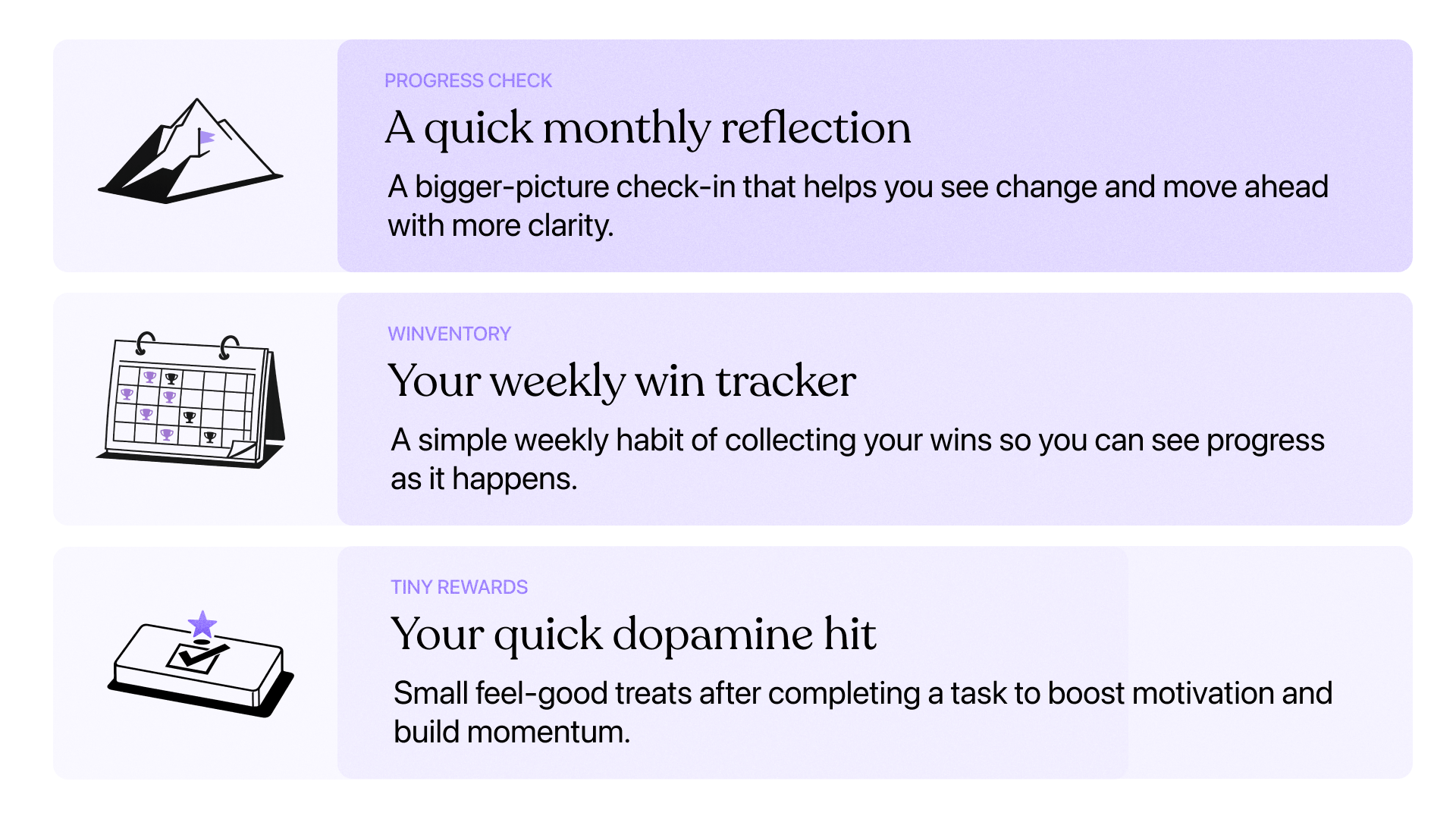
A Progress Check is a quick monthly reflection. It zooms you out to see how far you’ve come, even if day-to-day things still feel messy. Taking a step back helps reveal changes that are easy to miss in the middle of busy routines and shifting priorities.
Why it helps:
It’s easy to stay stuck in the loop of “what’s next?” and forget to ask “what’s better now?” Research on goal pursuit shows that recognizing progress improves persistence and supports ongoing motivation. This kind of reflection builds perspective by helping you notice what has improved, not just what still needs attention. It also creates space to adjust your approach without turning reflection into self-criticism.
How to try it:
Once a month, set aside 15 minutes to ask yourself:
What moved forward?
What got easier?
What still feels stuck, and why?
Then celebrate one thing. It could be tiny or big. Either way, it counts. Acknowledging progress reinforces the connection between effort and outcomes and helps maintain momentum over time.
💡 Pro tip: Create a Progress Check task in Tiimo and turn it in to a monthly ritual: Light a candle, make a snack, or turn on your favorite playlist. Make it something you want to come back to and use it as a gentle reminder to pause, reflect, and celebrate your growth.
Haz que tu energía rinda más
Tiimo te ayuda a priorizar, mantener el enfoque y avanzar con rutinas realistas y herramientas visuales que funcionan en el día a día.
A Winventory is your weekly win tracker. It’s a simple way to collect and celebrate progress as it happens. By gathering your wins in one place, it helps make effort visible instead of letting it fade into the background.
Why it works:
When you only focus on what’s left to do, you miss everything you’ve done. That’s a fast track to burnout. A Winventory shifts your attention toward progress and reminds you that movement is happening, even if everything is not finished yet. Noticing what went well helps reinforce the connection between effort and outcomes, making it easier to stay motivated over time.
Try this:
Once a week, jot down:
What went well?
What did I handle better than last week?
What would my past self high-five me for?
Make it visual if writing’s not your thing. Use sticky notes, voice memos, or even a photo album of wins to capture moments of progress in a way that feels natural.
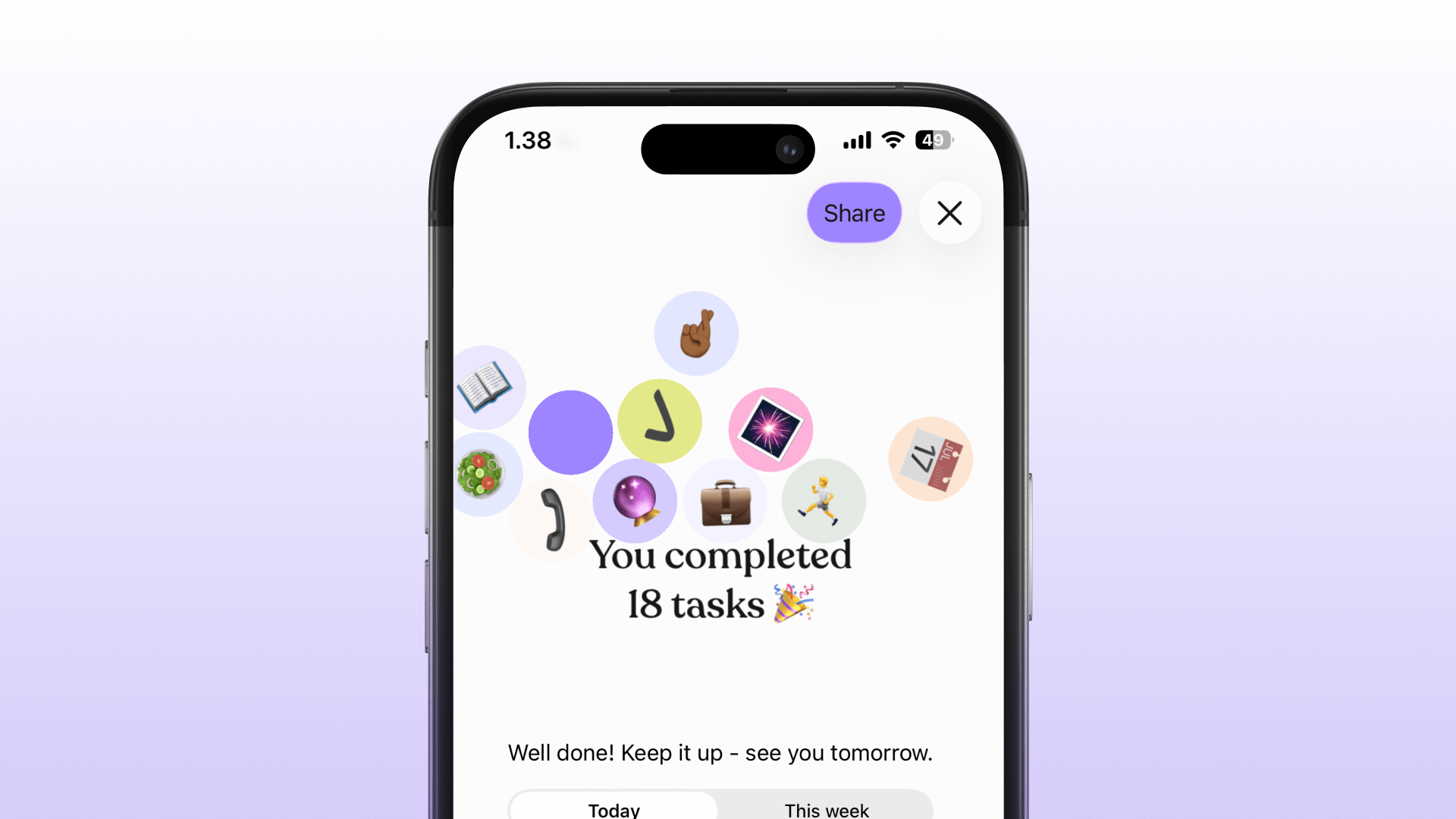
💡 Pro tip: Take a moment to celebrate your wins in Tiimo - big or small! Head to ‘Today’, tap the confetti icon in the top left corner, and soak it in. Psst… you can even style your bubbles! Add a cute emoji or your BFF’s photo under Visuals to make your tasks a little more you.
Tiimo helps you visualize your progress and celebratewhat you've completed, turning efforts into motivation.
Tiny Rewards
What is it?
Tiny Rewards are quick, satisfying treats you give yourself after completing a task. They create a small burst of motivation right when you need it and help mark the moment of completion.
Why it works:
The brain responds strongly to immediate feedback, and this is closely tied to how dopamine supports motivation. Research shows that dopamine neurons signal what is known as a reward prediction error, meaning they respond when an action is followed by a positive outcome as demonstrated by Schultz, Dayan and Montague in 1997. In simple terms, when you complete a task and immediately experience something positive, even something small, the brain registers that action as worthwhile. These small rewards help reinforce behavior by linking effort to outcome, making it more likely that you will repeat the action and sustain momentum over time.
How to try it:
Create a list of low-effort, feel-good rewards:
A funny video
A walk outside
Your favorite snack
A short break with music or a podcast
Think of them as a simple way to close the loop after effort, where the reward reinforces completion without turning into another decision to manage.
Motivation is not only a matter of completed tasks, it is also shaped by what you notice along the way. Pausing to reflect, reward effort, and reset perspective helps build a loop that supports steady momentum, even when progress feels slow. As you move through the week, consider which of these practices might be most helpful right now. Starting small is enough. Noticing that you made it this far already counts
References
Richard M. Ryan and Edward L. Deci, Self-Determination Theory and the Facilitation of Intrinsic Motivation, Social Development, and Well-Being, Americam Psychologist, January 2000.
W. Schultz, P. Dayan, P.R. Montague, A Neural Substrate of Prediction and Reward, Science Journal, March 1997.
Conoce a quien escribe
Mette Frid Darré
Mette is a communications and content intern at Tiimo, where she helps craft clear, inclusive messaging and user-friendly experiences for neurodivergent audiences.
Losing motivation? You’re not alone. You start the day with good intentions… and then? You blink, and it’s 3 PM. You’ve been busy, but nothing’s finished. That motivation spark? Gone. This guide shares two simple review techniques: Winventory and Progress Check and one feel-good habit called Tiny Rewards. Together, they can help you build momentum, stay consistent, and actually feel proud of your progress.
No items found.
Understanding motivation
Motivation is often framed as willpower, but research suggests it functions more like a feedback system than a personal trait. Self-Determination Theory, developed by Deci and Ryan (2000), shows that motivation grows when we experience competence, progress, and reinforcement, not when we simply try harder. In practical terms, this means motivation increases when effort produces visible signs of progress. When you can see movement, feel completion, or receive small positive feedback, your brain registers that your actions are effective. This is especially relevant for people navigating executive functioning challenges, ADHD task initiation difficulties, or inconsistent motivation patterns. When progress is visible, it supports follow-through and reduces the friction of getting started. But when you are juggling tasks, stress, and distractions, those signals often disappear. The brain naturally tracks what is unfinished rather than what is done, reinforcing a focus on what is still left to start or complete. Over time, this can create the feeling of being stuck, even when progress is happening, because attention stays fixed on the gap between effort and outcome rather than on what has already moved forward.
The hidden cost of tracking only what's left to do
Many planning systems naturally emphasize what still needs attention. While this helps with organization and clarity, it can also place more visibility on what remains open than on what has already moved forward. Over time, this can make progress harder to notice, even when meaningful steps are being taken. When effort is not reflected back through visible signals of completion, it becomes harder to connect action with impact. Instead of reinforcing momentum, attention can stay anchored on what is next rather than on what has already been done. Creating intentional ways to notice progress, reflect on what has improved, and reward effort can help rebalance this perspective. The following practices are designed to support exactly that.
Motivation grows when progress feels visible. Progress Check, Winventory, and Tiny Rewards are small habits that help you stay consistent and feel proud of what you have already done.
Progress Check
What is it?
A Progress Check is a quick monthly reflection. It zooms you out to see how far you’ve come, even if day-to-day things still feel messy. Taking a step back helps reveal changes that are easy to miss in the middle of busy routines and shifting priorities.
Why it helps:
It’s easy to stay stuck in the loop of “what’s next?” and forget to ask “what’s better now?” Research on goal pursuit shows that recognizing progress improves persistence and supports ongoing motivation. This kind of reflection builds perspective by helping you notice what has improved, not just what still needs attention. It also creates space to adjust your approach without turning reflection into self-criticism.
How to try it:
Once a month, set aside 15 minutes to ask yourself:
What moved forward?
What got easier?
What still feels stuck, and why?
Then celebrate one thing. It could be tiny or big. Either way, it counts. Acknowledging progress reinforces the connection between effort and outcomes and helps maintain momentum over time.
💡 Pro tip: Create a Progress Check task in Tiimo and turn it in to a monthly ritual: Light a candle, make a snack, or turn on your favorite playlist. Make it something you want to come back to and use it as a gentle reminder to pause, reflect, and celebrate your growth.
Haz que tu energía rinda más
Tiimo te ayuda a priorizar, mantener el enfoque y avanzar con rutinas realistas y herramientas visuales que funcionan en el día a día.
A Winventory is your weekly win tracker. It’s a simple way to collect and celebrate progress as it happens. By gathering your wins in one place, it helps make effort visible instead of letting it fade into the background.
Why it works:
When you only focus on what’s left to do, you miss everything you’ve done. That’s a fast track to burnout. A Winventory shifts your attention toward progress and reminds you that movement is happening, even if everything is not finished yet. Noticing what went well helps reinforce the connection between effort and outcomes, making it easier to stay motivated over time.
Try this:
Once a week, jot down:
What went well?
What did I handle better than last week?
What would my past self high-five me for?
Make it visual if writing’s not your thing. Use sticky notes, voice memos, or even a photo album of wins to capture moments of progress in a way that feels natural.
💡 Pro tip: Take a moment to celebrate your wins in Tiimo - big or small! Head to ‘Today’, tap the confetti icon in the top left corner, and soak it in. Psst… you can even style your bubbles! Add a cute emoji or your BFF’s photo under Visuals to make your tasks a little more you.
Tiimo helps you visualize your progress and celebratewhat you've completed, turning efforts into motivation.
Tiny Rewards
What is it?
Tiny Rewards are quick, satisfying treats you give yourself after completing a task. They create a small burst of motivation right when you need it and help mark the moment of completion.
Why it works:
The brain responds strongly to immediate feedback, and this is closely tied to how dopamine supports motivation. Research shows that dopamine neurons signal what is known as a reward prediction error, meaning they respond when an action is followed by a positive outcome as demonstrated by Schultz, Dayan and Montague in 1997. In simple terms, when you complete a task and immediately experience something positive, even something small, the brain registers that action as worthwhile. These small rewards help reinforce behavior by linking effort to outcome, making it more likely that you will repeat the action and sustain momentum over time.
How to try it:
Create a list of low-effort, feel-good rewards:
A funny video
A walk outside
Your favorite snack
A short break with music or a podcast
Think of them as a simple way to close the loop after effort, where the reward reinforces completion without turning into another decision to manage.
Motivation is not only a matter of completed tasks, it is also shaped by what you notice along the way. Pausing to reflect, reward effort, and reset perspective helps build a loop that supports steady momentum, even when progress feels slow. As you move through the week, consider which of these practices might be most helpful right now. Starting small is enough. Noticing that you made it this far already counts
References
Richard M. Ryan and Edward L. Deci, Self-Determination Theory and the Facilitation of Intrinsic Motivation, Social Development, and Well-Being, Americam Psychologist, January 2000.
W. Schultz, P. Dayan, P.R. Montague, A Neural Substrate of Prediction and Reward, Science Journal, March 1997.
About the author
Mette Frid Darré
Mette is a communications and content intern at Tiimo, where she helps craft clear, inclusive messaging and user-friendly experiences for neurodivergent audiences.
Losing motivation? You’re not alone. You start the day with good intentions… and then? You blink, and it’s 3 PM. You’ve been busy, but nothing’s finished. That motivation spark? Gone. This guide shares two simple review techniques: Winventory and Progress Check and one feel-good habit called Tiny Rewards. Together, they can help you build momentum, stay consistent, and actually feel proud of your progress.
Georgina Shute
Gina is an ADHD coach and founder of KindTwo, helping overwhelmed leaders reclaim time and build neuroinclusive systems that actually work.
No items found.
Understanding motivation
Motivation is often framed as willpower, but research suggests it functions more like a feedback system than a personal trait. Self-Determination Theory, developed by Deci and Ryan (2000), shows that motivation grows when we experience competence, progress, and reinforcement, not when we simply try harder. In practical terms, this means motivation increases when effort produces visible signs of progress. When you can see movement, feel completion, or receive small positive feedback, your brain registers that your actions are effective. This is especially relevant for people navigating executive functioning challenges, ADHD task initiation difficulties, or inconsistent motivation patterns. When progress is visible, it supports follow-through and reduces the friction of getting started. But when you are juggling tasks, stress, and distractions, those signals often disappear. The brain naturally tracks what is unfinished rather than what is done, reinforcing a focus on what is still left to start or complete. Over time, this can create the feeling of being stuck, even when progress is happening, because attention stays fixed on the gap between effort and outcome rather than on what has already moved forward.
The hidden cost of tracking only what's left to do
Many planning systems naturally emphasize what still needs attention. While this helps with organization and clarity, it can also place more visibility on what remains open than on what has already moved forward. Over time, this can make progress harder to notice, even when meaningful steps are being taken. When effort is not reflected back through visible signals of completion, it becomes harder to connect action with impact. Instead of reinforcing momentum, attention can stay anchored on what is next rather than on what has already been done. Creating intentional ways to notice progress, reflect on what has improved, and reward effort can help rebalance this perspective. The following practices are designed to support exactly that.
Motivation grows when progress feels visible. Progress Check, Winventory, and Tiny Rewards are small habits that help you stay consistent and feel proud of what you have already done.
Progress Check
What is it?
A Progress Check is a quick monthly reflection. It zooms you out to see how far you’ve come, even if day-to-day things still feel messy. Taking a step back helps reveal changes that are easy to miss in the middle of busy routines and shifting priorities.
Why it helps:
It’s easy to stay stuck in the loop of “what’s next?” and forget to ask “what’s better now?” Research on goal pursuit shows that recognizing progress improves persistence and supports ongoing motivation. This kind of reflection builds perspective by helping you notice what has improved, not just what still needs attention. It also creates space to adjust your approach without turning reflection into self-criticism.
How to try it:
Once a month, set aside 15 minutes to ask yourself:
What moved forward?
What got easier?
What still feels stuck, and why?
Then celebrate one thing. It could be tiny or big. Either way, it counts. Acknowledging progress reinforces the connection between effort and outcomes and helps maintain momentum over time.
💡 Pro tip: Create a Progress Check task in Tiimo and turn it in to a monthly ritual: Light a candle, make a snack, or turn on your favorite playlist. Make it something you want to come back to and use it as a gentle reminder to pause, reflect, and celebrate your growth.
Winventory
What is it?
A Winventory is your weekly win tracker. It’s a simple way to collect and celebrate progress as it happens. By gathering your wins in one place, it helps make effort visible instead of letting it fade into the background.
Why it works:
When you only focus on what’s left to do, you miss everything you’ve done. That’s a fast track to burnout. A Winventory shifts your attention toward progress and reminds you that movement is happening, even if everything is not finished yet. Noticing what went well helps reinforce the connection between effort and outcomes, making it easier to stay motivated over time.
Try this:
Once a week, jot down:
What went well?
What did I handle better than last week?
What would my past self high-five me for?
Make it visual if writing’s not your thing. Use sticky notes, voice memos, or even a photo album of wins to capture moments of progress in a way that feels natural.
💡 Pro tip: Take a moment to celebrate your wins in Tiimo - big or small! Head to ‘Today’, tap the confetti icon in the top left corner, and soak it in. Psst… you can even style your bubbles! Add a cute emoji or your BFF’s photo under Visuals to make your tasks a little more you.
Tiimo helps you visualize your progress and celebratewhat you've completed, turning efforts into motivation.
Tiny Rewards
What is it?
Tiny Rewards are quick, satisfying treats you give yourself after completing a task. They create a small burst of motivation right when you need it and help mark the moment of completion.
Why it works:
The brain responds strongly to immediate feedback, and this is closely tied to how dopamine supports motivation. Research shows that dopamine neurons signal what is known as a reward prediction error, meaning they respond when an action is followed by a positive outcome as demonstrated by Schultz, Dayan and Montague in 1997. In simple terms, when you complete a task and immediately experience something positive, even something small, the brain registers that action as worthwhile. These small rewards help reinforce behavior by linking effort to outcome, making it more likely that you will repeat the action and sustain momentum over time.
How to try it:
Create a list of low-effort, feel-good rewards:
A funny video
A walk outside
Your favorite snack
A short break with music or a podcast
Think of them as a simple way to close the loop after effort, where the reward reinforces completion without turning into another decision to manage.
Motivation is not only a matter of completed tasks, it is also shaped by what you notice along the way. Pausing to reflect, reward effort, and reset perspective helps build a loop that supports steady momentum, even when progress feels slow. As you move through the week, consider which of these practices might be most helpful right now. Starting small is enough. Noticing that you made it this far already counts
References
Richard M. Ryan and Edward L. Deci, Self-Determination Theory and the Facilitation of Intrinsic Motivation, Social Development, and Well-Being, Americam Psychologist, January 2000.
W. Schultz, P. Dayan, P.R. Montague, A Neural Substrate of Prediction and Reward, Science Journal, March 1997.
Build routines that work with ADHD
When you're ready, try Tiimo and make structure a little easier.
You’ve got plenty of energy, so why can’t you use it on the task that matters? Learn what blocks ADHD motivation and how to make difficult tasks easier to start.